US House Passes Crypto GENIUS Act — A Win for Industry Advocates
The US House sent the crypto GENIUS Act to Trump, marking a landmark win for crypto industry advocates and reshaping stablecoin regulation in America.

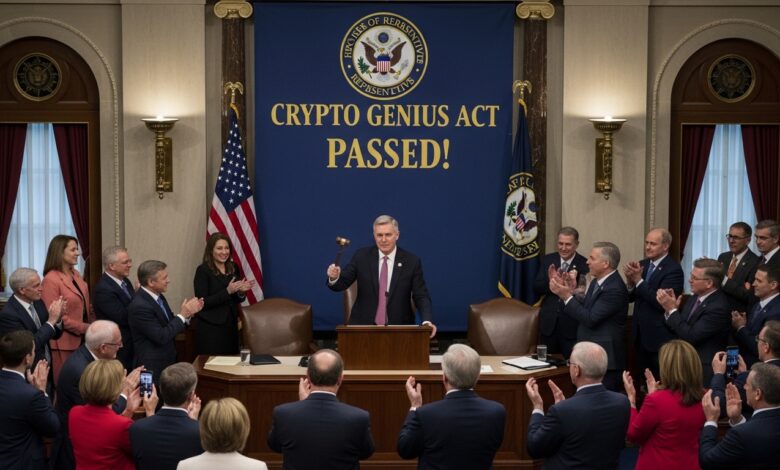
In a defining moment for the future of digital finance, the US House of Representatives passed the crypto GENIUS Act, sending it directly to President Donald Trump’s desk — and marking a resounding win for crypto industry advocates across the country. The House approved the landmark legislation on July 17, 2025, in a strong 308–122 bipartisan vote, capping off what Republican lawmakers proudly dubbed “Crypto Week.” Trump signed the bill into law the very next day, July 18, 2025, in a ceremony at the White House East Room attended by lawmakers and top executives from firms including Robinhood, Tether, and Gemini. The GENIUS Act — which stands for Guiding and Establishing National Innovation for U.S.
What Is the GENIUS Act? Understanding the Landmark Crypto Legislation
The GENIUS Act is a comprehensive federal law that creates a regulatory framework specifically tailored for payment stablecoins — a category of cryptocurrency whose value is pegged to a stable asset, most commonly the U.S. dollar.
Introduced by Republican Senator Bill Hagerty on May 21, 2025, the GENIUS Act stablecoin framework quickly gained bipartisan momentum. The Senate passed the bill on June 17, 2025, in a 68–30 vote, with the majority of Republicans and roughly half of all Democrats voting in favor. The House followed suit in July, completing the bill’s journey to Trump’s desk.
At its core, the law requires that every stablecoin in circulation be backed one-for-one with liquid assets — such as U.S. dollars or short-term Treasury securities. This reserve requirement is designed to ensure that consumers can always redeem their stablecoins at face value, even during periods of financial stress. Issuers must also publish monthly, transparent disclosures about the composition of their reserves, offering a level of accountability that previously did not exist for the digital asset space.
Key Provisions That Reshaped Stablecoin Regulation
The GENIUS Act stablecoin regulation introduced several provisions that will have lasting implications for the cryptocurrency industry. All permitted payment stablecoin issuers are now required to comply with the Bank Secrecy Act, meaning they must implement robust anti-money laundering (AML) programs, conduct sanctions list verification, and maintain customer identification protocols. These requirements bring stablecoin issuers into closer regulatory alignment with traditional banks and financial institutions.
In addition, the law mandates that all stablecoin issuers possess the technical capability to freeze, seize, or permanently destroy stablecoins when legally required to do so.
The legislation also draws a firm line between State and Federal frameworks, harmonizing regulations so that businesses operating across multiple jurisdictions face consistent rules rather than a patchwork of conflicting requirements. And crucially, in the event that a stablecoin issuer becomes insolvent, the GENIUS Act prioritizes the claims of stablecoin holders above all other creditors — a direct consumer protection measure meant to prevent the kind of financial fallout that devastated investors in past crypto collapses.
The US House Sends Crypto GENIUS Act to Trump — A Win for Crypto Industry Advocates
The passage of the crypto GENIUS Act was not without drama. A small group of conservative House Republicans initially blocked the bill earlier in the week, creating a procedural standoff that forced House Speaker Mike Johnson to delay the final vote. The dispute required direct intervention from President Trump himself, who met with the holdout lawmakers on a Tuesday night before negotiations with House leadership broke the impasse the following day.
The procedural vote that ultimately cleared the path for final passage set an extraordinary record — it was held open for 9 hours and 40 minutes, becoming the longest U.S. House vote in modern history. The prolonged standoff underscored just how consequential the legislation was seen to be on both sides of the aisle.
When the GENIUS Act finally passed in its decisive 308–122 vote, it signaled a sea change in American attitudes toward cryptocurrency regulation. For years, U.S. crypto businesses had operated in a grey zone defined by unclear and sometimes contradictory rules enforced by competing agencies. The new law changes that, giving the crypto industry the “clear rules of the road” that advocates had long demanded.
David Sacks, President Trump’s AI and Crypto Czar and the venture capitalist who played a key role in shepherding the bill, told the President at the signing ceremony that the legislation represented “a monumental step to fulfilling your promise to make the United States the Crypto Capital of the world.” Trump, for his part, quipped that they had named the act after him — and promised that it was “one hell of an act.”
Industry Leaders React to the GENIUS Act Signing
The signing ceremony drew an enthusiastic response from across the digital asset industry. Paxos CEO Charles Cascarilla said the law made real a vision years in the making — that “well-regulated stablecoins are the bridge between traditional finance and blockchain innovation.” Exodus CEO JP Richardson predicted that every bank in America would eventually adopt stablecoins, describing the moment as “a watershed moment for crypto and the U.S. dollar.”
Dante Disparte, chief strategy officer of Circle — the company behind the widely used USDC stablecoin — said the bill’s passage sends “a clear message that the U.S. will lead in the regulation of dollar-backed payment stablecoins.” Treasury Secretary Scott Bessent added that blockchain technologies would power the next generation of payments and that the GENIUS Act would help cement the U.S. dollar as the global reserve currency for generations to come.
How the GENIUS Act Strengthens U.S. Dollar Dominance in the Digital Age
One of the most strategically significant aspects of the GENIUS Act crypto legislation is its potential to reinforce the dominance of the U.S. dollar in global finance. By requiring that all payment stablecoins be backed by dollar-denominated assets or short-term U.S. Treasuries, the law effectively exports demand for American financial instruments across the global digital currency ecosystem.
As more commerce, remittances, and financial settlements move onto blockchain rails, the dollar-backed stablecoin becomes a de facto global payment medium — extending U.S. monetary influence into parts of the financial world that traditional banking has struggled to reach. The GENIUS Act stablecoin framework thus serves a dual purpose: it protects American consumers at home while amplifying American financial power abroad.
Treasury Secretary Bessent’s vision — that “the U.S. dollar is coming onchain” — captures the broader geopolitical ambition behind the legislation. In an era where China has been aggressively developing its own central bank digital currency, the United States is betting that a privately issued, dollar-backed stablecoin regulated under the GENIUS Act will be more globally appealing than any government-run alternative.
What the GENIUS Act Means for Banks, Fintechs, and Consumers
With the GENIUS Act now signed into law, the door has opened for a broad new category of market participants. Banks, non-bank financial institutions, and credit unions can now apply to become permitted payment stablecoin issuers, diving into a market that had previously been dominated by a handful of crypto-native companies. Tech giants like Walmart and Amazon have reportedly explored stablecoin issuance, and the new regulatory clarity could accelerate those conversations.
Criticism and Controversy Surrounding the Crypto GENIUS Act
No landmark legislation passes without opposition, and the GENIUS Act was no exception. Democrats who opposed the bill raised several pointed concerns, many of which centered on conflicts of interest at the highest levels of government.
One of the most notable critiques focused on a glaring asymmetry in the bill’s ethics provisions. While the legislation bans members of Congress and their immediate families from profiting off stablecoins, that prohibition does not extend to the President or his family. This matters because President Trump’s family holds a significant stake in World Liberty Financial, a crypto venture that has issued its own stablecoin called USD1. Trump reported earning more than $57 million from token sales at World Liberty Financial in 2024 alone.
Critics from consumer advocacy groups also argued that the GENIUS Act stablecoin regulation lacks the teeth needed to truly protect the public. Consumer advocacy group Better Markets called the bill “all hype,” arguing that while problems exist in the current payment system, the GENIUS Act does not solve them — and may exacerbate some.
What Comes Next: The CLARITY Act and the Future of Crypto Regulation
The GENIUS Act may be the first major crypto legislation to become law, but it is unlikely to be the last. During “Crypto Week,” the House also passed two additional cryptocurrency-related bills — the Digital Asset Market Clarity Act (the CLARITY Act) and a third measure — both of which now await Senate consideration.
It would determine whether a given cryptocurrency is classified as a security (regulated by the SEC) or a commodity (regulated by the CFTC), and would shift a significant amount of regulatory oversight toward the CFTC. Industry advocates argue this shift would provide clearer, more workable rules; critics fear it would result in far weaker oversight of a volatile and often risky sector.
The passage of the GENIUS Act has demonstrated that bipartisan consensus around digital asset regulation is achievable — and that the political winds are currently blowing in the crypto industry’s favor. With the crypto market cap hitting a record $4 trillion in the aftermath of the House vote, investors and industry participants are watching Washington closely for signals about what comes next.
Conclusion
Whether you are an investor, a fintech entrepreneur, a policymaker, or simply someone who uses digital payments, the GENIUS Act will affect your financial world in ways that are only beginning to become clear.
Stay ahead of the rapidly evolving world of crypto regulation. Bookmark this page, subscribe to our newsletter for the latest updates on the GENIUS Act stablecoin framework, the upcoming CLARITY Act, and every other development in U.S. digital asset policy — because in the world of crypto, the next big change is always just around the corner.
See more;Ethereum Blockchain Trilemma: Vitalik’s ZK-EVM Solution