Steak ‘n Shake Bitcoin Payments Boost Sales Dramatically in 9 Months
Steak 'n Shake Bitcoin payments have lifted same-store sales dramatically in just 9 months. Discover how the fast-food chain is rewriting crypto commerce.

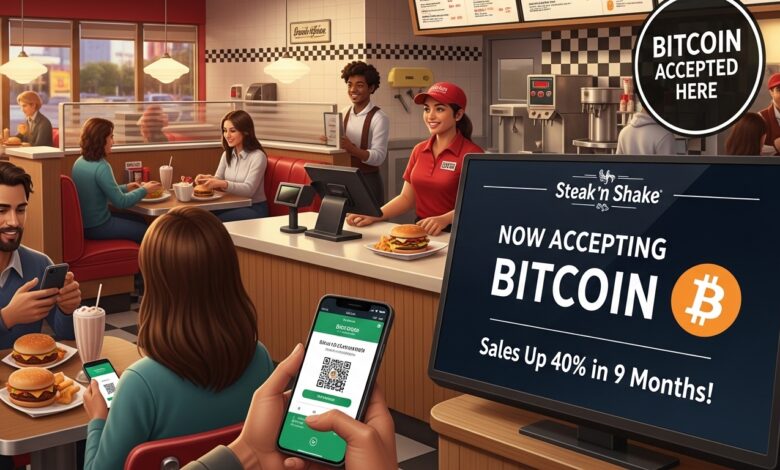
Steak ‘n Shake Bitcoin payments boost sales has become the headline story of early 2026. The iconic American fast-food chain, which launched Bitcoin acceptance in May 2025, announced on February 17, 2026, that its same-store sales have risen “dramatically” in the nine months since the rollout began. What started as a bold experiment has evolved into a full-scale digital asset strategy — one that is not only driving customers through the door but also fundamentally reshaping how the company manages its revenue, treasury, and employee compensation.
The announcement, made via the company’s official X (formerly Twitter) account, caught the attention of the crypto community, traditional investors, and fast-food industry watchers alike. Steak ‘n Shake, operated by the publicly listed Biglari Holdings, did not provide exact revenue figures, but the directional claim is striking: accepting Bitcoin as a payment method has been one of the most impactful business decisions the chain has made in recent memory. For a 91-year-old brand competing in an increasingly crowded fast-food landscape, that is no small statement.
How Steak ‘n Shake Bitcoin Payments Boost Sales: The Origin Story
The path to Bitcoin acceptance did not happen overnight. Steak ‘n Shake spent months building anticipation, engaging its community through social media polls and public endorsements from high-profile figures including Jack Dorsey, the co-founder of Twitter and Square. When the company officially launched Bitcoin payments via the Lightning Network on May 16, 2025, across all U.S. locations, it had already cultivated a core audience of crypto-enthusiast customers eager to pay with digital currency.
The Lightning Network was a critical infrastructure choice. Unlike standard Bitcoin transactions on the base layer — which can take ten minutes or more to confirm — the Lightning Network enables near-instant, low-fee Bitcoin payments, making it practical for a high-volume fast-food environment where speed at the register is everything. Within just two weeks of launch, COO Dan Edwards reported that the company was already saving approximately 50% on transaction processing fees compared to traditional card payments — a meaningful margin improvement for a business that operates on razor-thin restaurant profit margins.
That early operational win helped validate the strategy internally. Same-store sales initially rose around 10% in the early months of Bitcoin acceptance, a figure that has since climbed further as the program matured and gained visibility. The company’s “burger-to-Bitcoin transformation,” as it called it on its nine-month anniversary post, had clearly resonated with a new segment of customers seeking businesses that align with their financial and philosophical values.
The Bitcoin Steakburger and Early Promotional Momentum
In October 2025, Steak ‘n Shake added a new dimension to its crypto push: the Bitcoin Steakburger, a limited-edition menu item stamped with the Bitcoin logo. For every “Bitcoin Meal” sold, the company donated 210 satoshis — tiny fractions of a Bitcoin — to open-source Bitcoin software development. It was a smart piece of brand storytelling that deepened the company’s credibility within the Bitcoin community and generated organic media coverage that money cannot easily buy.
These promotional efforts were not mere gimmicks. They signaled to Bitcoin enthusiasts that Steak ‘n Shake was not treating crypto as a temporary marketing tool but as a genuine part of its identity. “Our allegiance is with Bitcoiners,” the company famously declared after briefly surveying customers about Ethereum acceptance and then pulling the poll entirely in response to community pushback.
The Strategic Bitcoin Reserve: Where Every Payment Goes
One of the most distinctive elements of Steak ‘n Shake’s approach is what happens to Bitcoin after customers pay. Rather than converting Bitcoin payments into U.S. dollars — as most merchants do — the company routes all BTC directly into what it calls a Strategic Bitcoin Reserve (SBR). This decision separates Steak ‘n Shake from virtually every other fast-food chain that has dabbled in cryptocurrency.
The reserve has grown steadily. After an initial $10 million Bitcoin treasury purchase in late 2025, the company added another $10 million on January 16, 2026, and a further $5 million on January 27, 2026. As of the nine-month anniversary announcement, Steak ‘n Shake holds approximately 161–168.6 BTC valued at roughly $11–$15 million, depending on market conditions. Data from BitcoinTreasuries shows the company’s average acquisition price sits around $92,851 per BTC.
The company describes this structure as a self-reinforcing cycle: customers pay in Bitcoin, same-store sales rise, the reserve grows, and the accumulated crypto funds new operational and compensation initiatives. “We have combined a decentralized, cash-producing operating business with the transformative power of Bitcoin,” the company stated in its anniversary post. It is a remarkably coherent financial narrative for a fast-food chain — and one that corporate strategists are beginning to take seriously.
What Makes the Strategic Bitcoin Reserve Different From Other Corporate BTC Holdings
Unlike companies such as MicroStrategy (now Strategy) or Tesla, which hold Bitcoin purely as a treasury asset, Steak ‘n Shake has integrated its Bitcoin corporate reserve directly into its revenue cycle. Every burger paid for in BTC contributes to the reserve, which then flows back into the business through employee bonuses. This operational loop gives the reserve a functional purpose beyond simple price speculation — it is a mechanism for sharing digital asset gains with workers while simultaneously signaling company values to customers.
Vineet Budki, CEO of venture capital firm Sigma Capital, called the model “what a real digital asset treasury model looks like,” distinguishing it from companies where Bitcoin is effectively the entire business. “Compare this to companies where Bitcoin is the business model, where the stock is just a leveraged Bitcoin proxy,” Budki told Decrypt. “Corporate Bitcoin adoption won’t come from crypto-native firms — it’ll come from traditional businesses treating Bitcoin like what it is: digital gold on a balance sheet, not a business plan.”
Bitcoin Bonus for Employees: A New Kind of Compensation Model
Perhaps the most socially significant aspect of Steak ‘n Shake’s Bitcoin strategy is its employee compensation program. In late January 2026, the company announced that all hourly workers at company-operated restaurants would receive a Bitcoin bonus of $0.21–$0.27 per hour worked, beginning March 1, 2026, with a two-year vesting period. It was a pioneering move: a national restaurant chain using a cryptocurrency reserve funded by customer payments to distribute digital wealth to its frontline workforce.
The program is not without complexity. The two-year vesting schedule has drawn some criticism from employees who cannot immediately access the funds, and franchise workers at non-corporate locations are excluded from the plan entirely. These are real limitations that the company will need to address as the program matures. Nevertheless, the concept of Bitcoin-denominated employee bonuses funded by a customer-driven reserve is genuinely novel in the restaurant industry, and it has attracted significant positive press coverage and customer goodwill.
Steak ‘n Shake Bitcoin Payments Boost Sales: The Numbers Behind the Claim
When Steak ‘n Shake says its same-store sales have risen dramatically since accepting Bitcoin, what do the available data points tell us? While the company has not released a detailed revenue breakdown attributing specific dollar amounts to crypto payments, the trajectory is clear from the disclosures made over nine months.
The chain reported double-digit same-store sales growth in the second half of 2025, a period that coincides precisely with its Bitcoin launch. For 2026, early data shows 18% growth at existing stores, outpacing most fast-food competitors operating in the same environment. These are not fringe numbers — 18% same-store sales growth is the kind of performance that attracts institutional investor attention and media coverage in any economic climate.
The Lightning Network payment infrastructure also deserves credit for part of the financial improvement. The 50% reduction in payment processing fees translates directly to margin improvement at scale. For a chain with hundreds of locations processing thousands of transactions daily, shaving processing costs in half is a material contribution to profitability — one that does not require a single additional customer to walk through the door.
Comparing Steak ‘n Shake to Other Bitcoin-Accepting Businesses
Steak ‘n Shake’s success stands in instructive contrast to the struggles of earlier Bitcoin-accepting merchants. Microsoft and Expedia both integrated and later restricted Bitcoin payments due to the practical difficulties of handling cancellations and modifications with an irreversible payment protocol. Tesla famously suspended Bitcoin acceptance in 2021 citing environmental concerns. These high-profile retreats contributed to a broader narrative that Bitcoin payments in retail were impractical.
Steak ‘n Shake avoided those pitfalls by choosing the Lightning Network, which processes payments off the Bitcoin base layer, dramatically reducing fees and confirmation times. The fast-food model is also better suited to Bitcoin than e-commerce: transactions are final with no returns or cancellations, which eliminates the chargeback and reversal challenges that plagued travel and software merchants. Samuel Patt, co-founder of Bitcoin tech firm op_net, acknowledged that Steak ‘n Shake is “an outlier” given that broader merchant demand for Bitcoin has declined in recent years — but noted that when large merchants prove the model works in practice, they create a template for others to follow.
Global Ambitions: El Salvador and the Bitcoin-Aligned Expansion Strategy
Steak ‘n Shake’s Bitcoin-first business model is not limited to U.S. operations. The company already operates locations across several European countries, including France, Italy, Portugal, and Monaco. More significantly, Steak ‘n Shake has announced plans to expand into El Salvador — the first country in the world to recognize Bitcoin as legal tender. Company representatives attended Bitcoin events in San Salvador in November 2025 and formalized expansion plans shortly after.
Entering El Salvador is a strategic move that goes beyond simple market expansion. It positions Steak ‘n Shake as a Bitcoin-native brand in the global consumer consciousness — a distinction that attracts a loyal, high-engagement customer base willing to go out of their way to support businesses that share their values. The El Salvador market, while small, carries outsized symbolic importance for a company building its identity around Bitcoin.
What Steak ‘n Shake’s Bitcoin Success Means for the Fast-Food Industry
The broader implications of Steak ‘n Shake accepting Bitcoin payments go well beyond one fast-food chain’s quarterly results. If a 91-year-old American burger brand can integrate Bitcoin Lightning Network payments into its operations, reduce transaction costs by 50%, and drive double-digit same-store sales growth — all while building a treasury reserve and funding employee bonuses — it challenges the conventional wisdom that crypto payments are too complicated for mainstream retail.
The transaction fee savings argument alone is compelling for an industry where margins are typically in the single digits. Credit and debit card processing fees average 2–3% per transaction across the restaurant industry. Cutting that in half with Lightning Network payments could mean the difference between profitability and loss at the unit level for many operators. Bitcoin payment adoption in restaurants could accelerate quickly if Steak ‘n Shake’s numbers hold and other chains take notice.
The corporate Bitcoin reserve model is equally instructive. Rather than treating crypto payments as a niche add-on to be converted to dollars immediately, Steak ‘n Shake has built a coherent treasury strategy around accumulating BTC from operations. As Bitcoin’s long-term value proposition continues to gain mainstream acceptance, this model could prove to be a significant source of balance sheet appreciation that traditional restaurant companies simply do not have access to.
Challenges and Risks the Company Still Faces
Not everything about Steak ‘n Shake’s Bitcoin commerce strategy is without risk. The company’s BTC holdings currently sit approximately 26% below their average acquisition price, reflecting Bitcoin’s volatile price history. If Bitcoin were to enter a prolonged bear market, the reserve’s dollar value would decline, potentially complicating the employee bonus program and the narrative of success the company has built.
Regulatory uncertainty also looms. Biglari Holdings, Steak ‘n Shake’s parent company, has not yet indicated whether the Bitcoin strategy will expand company-wide or remain a brand-specific initiative. Future SEC filings and earnings calls will provide more clarity on how the financial community views the risk profile of a restaurant chain with a growing cryptocurrency balance sheet. Additionally, scaling Lightning Network payments globally — particularly in European markets with different regulatory frameworks — presents logistical and compliance challenges that the company will need to navigate carefully.
Conclusion
The story of Steak ‘n Shake Bitcoin payments boosting sales is ultimately a story about a legacy brand willing to make a structural bet on the future of money. In just nine months, the chain has achieved what many skeptics said was impossible: using Bitcoin as a genuine payment mechanism, building a Strategic Bitcoin Reserve from operational cash flows, reducing processing costs dramatically, and driving same-store sales growth that outpaces the industry.
Whether the numbers sustain themselves over the next nine months — and beyond — will determine whether Steak ‘n Shake becomes a Bitcoin commerce blueprint for the restaurant industry or remains an intriguing outlier. For now, the evidence is compelling: customers are voting with their wallets, and those wallets increasingly contain Bitcoin.
Steak n Shake Bitcoin payments | Steak n Shake accepts Bitcoin | fast food Bitcoin Lightning Network | Steak n Shake Strategic Bitcoin Reserve | Biglari Holdings Bitcoin | restaurant crypto payments 2025 | Bitcoin same-store sales growth | Lightning Network fast food | Bitcoin Steakburger | Steak n Shake BTC bonus employees | Bitcoin merchant adoption US | corporate Bitcoin reserve strategy | how to accept Bitcoin Lightning payments | Bitcoin fast food ch
See more: Second Suspect Arrested in Crypto Torture Scheme Case