House Democrat Proposes Ban on Government Officials Issuing Meme Coins
A House Democrat proposes a ban on government officials issuing meme coins with the MEME Act, targeting crypto conflicts of interest in Washington.

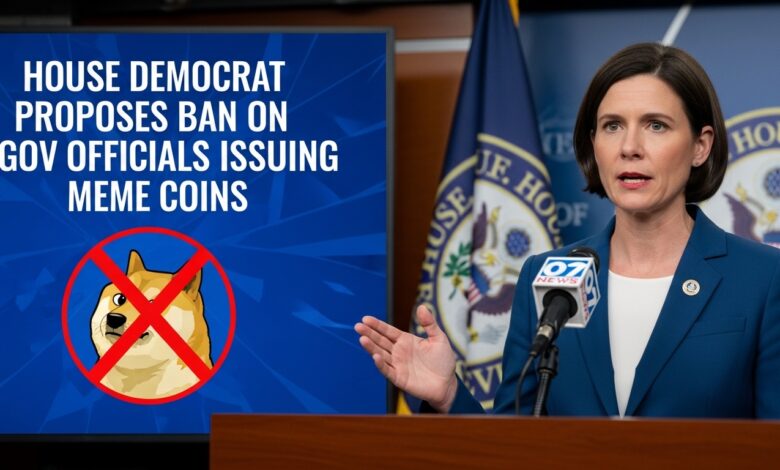
A new chapter in the intersection of politics and cryptocurrency has arrived on Capitol Hill. A House Democrat has formally proposed a ban on government officials issuing meme coins, introducing legislation that could reshape how America’s top public servants interact with the booming digital asset market. Sam Liccardo and has sent shockwaves through both Washington and the crypto community. As covered by CNBC Crypto World, this bold proposal comes at a time when the line between political power and personal crypto profit has never been blurrier, raising urgent questions about ethics, transparency, and the future of digital asset regulation in the United States.
Why a House Democrat Is Pushing to Ban Government Officials From Issuing Meme Coins
The push for a ban on government officials issuing meme coins didn’t emerge in a vacuum. It follows a period of intense controversy surrounding the launch of the $TRUMP meme coin — a digital token introduced by President Donald Trump just days before he took office in January 2025. The coin surged in value almost immediately, attracting hundreds of thousands of investors hoping to capitalize on the Trump brand. First Lady Melania Trump also launched her own meme coin around the same time, adding to what critics called an unprecedented and deeply troubling blurring of executive power and personal financial gain.
Representative Sam Liccardo wasted no time in calling the situation out for what he believes it is: corruption. “Let’s make corruption criminal again,” Liccardo said in a statement, arguing that the Trumps’ issuance of meme coins financially exploits the public for personal gain and raises the specter of insider trading and even foreign influence over the Executive Branch. The freshman Democrat from California quickly gathered over a dozen co-sponsors — all Democrats — ranging from Ro Khanna and Eric Swalwell to Ted Lieu and Eleanor Holmes Norton, reflecting the depth of concern within the party over presidential crypto dealings.
The MEME Act targets a specific and troubling gap in current ethics law: there are no explicit rules preventing a sitting president, vice president, member of Congress, or senior executive branch official from launching or promoting a digital asset while holding public office. Liccardo’s bill aims to close that loophole permanently.
What the MEME Act Actually Proposes: A Closer Look
At its core, the MEME Act seeks to prohibit the president, vice president, members of Congress, senior executive branch officials, and their spouses and dependent children from issuing, sponsoring, or endorsing any security, commodity, future, or digital asset. That’s a broad mandate that goes well beyond just meme coins — it also covers stablecoins, tokenized stocks, and other financial instruments that powerful public officials might use to enrich themselves at the public’s expense.
One of the most consequential features of the proposed legislation is its retroactive application. If passed, the bill would apply to assets already issued before its enactment, including the $TRUMP and Melania coins launched in January 2025. This retroactive element makes the MEME Act not just a forward-looking ethics measure, but a direct rebuke of conduct that has already occurred under the current administration.
The bill also provides a private right of action, allowing investors who lost money on a meme coin backed or promoted by a public official to sue for damages. Representative Liccardo argued that this provision is essential given broader concerns about the independence of the Justice Department under the current administration. If government enforcement mechanisms cannot be relied upon, private citizens should have the tools to hold powerful wrongdoers accountable themselves.
Criminal and civil penalties would apply to any person who violates the law’s prohibitions. This dual enforcement mechanism — both criminal prosecution and civil litigation — signals that sponsors of the bill are serious about deterrence, not just symbolic lawmaking.
The $TRUMP Meme Coin: How It All Started
To understand why Democrats feel so urgently about a ban on government officials issuing meme coins, it helps to understand the timeline and scale of the controversy surrounding the $TRUMP token. Launched in mid-January 2025, just days before the presidential inauguration, the $TRUMP meme coin quickly became one of the most talked-about digital assets in the world. Its price skyrocketed almost overnight, drawing in both retail investors and well-heeled speculators hoping to profit from the Trump name.
But the early enthusiasm gave way to a steep decline. As early investors dumped their holdings, the coin’s value tanked, leaving hundreds of thousands of retail investors with significant losses. The coin’s rapid rise and crash became a symbol of what critics call the dangers of allowing political figures to issue crypto assets while simultaneously holding the power to shape regulatory policy.
Adding fuel to the fire, the Trump administration later organized what critics described as a “pay-for-play” arrangement: a private dinner at the president’s golf club for top $TRUMP meme coin investors, offering a “VIP White House tour” alongside the dinner. The promotion sent the coin’s price soaring temporarily, but it also attracted intense scrutiny from lawmakers, ethics watchdogs, and legal scholars. Senator Richard Blumenthal of Connecticut launched a formal inquiry into the matter, demanding records from the company behind the $TRUMP coin and citing what he called “unprecedented conflicts of interest and national security risks.”
Ban on Government Officials Issuing Meme Coins: The Broader Democratic Response
The MEME Act is only one piece of a much larger Democratic effort to rein in what the party describes as crypto-enabled corruption at the highest levels of government. In the Senate, Connecticut Democrat Chris Murphy introduced a companion measure with similar aims, while Massachusetts Senator Elizabeth Warren pushed for stablecoin legislation to include explicit prohibitions on government officials using such assets to enrich themselves.
California Representative Maxine Waters convened a Democrat-only session focused squarely on Trump’s meme coin and World Liberty Financial, introducing a discussion draft that would ban the president and members of Congress from owning crypto assets or financially benefiting from them. The Senate’s “End Crypto Corruption Act,” unveiled around the same time, represents yet another legislative attempt to draw a firm ethical boundary between public service and personal crypto profit.
The Trump administration’s involvement in crypto extends even further than meme coins. The Trump family holds a significant stake in World Liberty Financial, a crypto project that has launched its own stablecoin, USD1. A meme coin linked to the president has generated an estimated $320 million in fees, though the earnings are split among multiple investors. That kind of financial entanglement, Democrats argue, makes objective crypto policymaking nearly impossible and potentially illegal.
Despite the urgency behind these proposals, the political reality is stark. With Republicans controlling both chambers of Congress, the MEME Act and its companion bills have little chance of becoming law in the near term. But Democrats have made clear that their goal extends beyond immediate legislative success — they are building a public record, pressuring colleagues across the aisle, and laying the groundwork for future action.
H3: How the MEME Act Addresses Foreign Influence and Insider Trading Risks
Beyond the ethics questions, proponents of the MEME Act point to two specific and serious national security risks posed by government officials participating in the crypto market: insider trading and foreign influence.
Because public officials routinely receive non-public information about regulatory decisions, economic policy, and geopolitical developments, they hold an inherent informational advantage over ordinary investors. In the opaque world of cryptocurrency — where transactions can be difficult to trace and ownership can be obscured — this creates fertile ground for potential abuse. An official who knows, for example, that a favorable crypto regulation is about to be enacted could quietly invest in a digital asset before the announcement and profit handsomely without detection.
The foreign influence concern is equally serious. As Senator Blumenthal’s inquiry noted, the ability of foreign actors to purchase large quantities of a politically branded meme coin — potentially delivering millions of dollars to a sitting president or high-ranking official — represents an entirely new kind of soft corruption. Unlike traditional campaign finance, meme coin purchases aren’t subject to the same transparency and disclosure requirements, making them a potentially powerful and covert tool for foreign governments seeking to curry favor with American leadership.
The MEME Act attempts to neutralize both risks by simply removing the opportunity for officials to participate in these markets at all.
H3: Crypto Community Reactions and Political Divides
The reaction to the proposed ban on government officials issuing meme coins has been predictably split along both political and ideological lines. Crypto advocates who support the Trump administration’s broader pro-crypto agenda have largely dismissed the MEME Act as partisan grandstanding. Many in the industry point out that Trump’s embrace of cryptocurrency — including his promise to make the U.S. the “crypto capital of the world” — has been broadly good for the market and for innovation.
On the other side of the debate, consumer advocates, ethics lawyers, and many retail investors who lost money on the $TRUMP coin have welcomed the proposal as a necessary corrective. They argue that when the president of the United States can launch a meme coin and then use his platform to drive its price, the entire concept of a fair and transparent market breaks down.
CNBC Crypto World highlighted the broader market implications of the controversy, noting that the political drama surrounding presidential meme coins contributed to a significant crypto market pullback in early 2025. Alice Liu of CoinMarketCap pointed to the uncertainty generated by regulatory threats and political controversy as one of the major drivers behind the downturn — a reminder that Washington’s actions, and inactions, have real consequences for crypto markets worldwide.
What Happens Next: The Road Ahead for Crypto Ethics Legislation
Even if the MEME Act fails to advance under the current Republican majority, the political dynamics around crypto ethics and government officials are shifting in ways that could matter in the long run. A growing number of voters — not just on the left, but across the political spectrum — are concerned about conflicts of interest in government crypto dealings. As digital assets become more mainstream, the pressure on lawmakers to establish clear ethical guardrails will only intensify.
The stablecoin legislation that advanced through Congress in 2025 did include a provision banning members of Congress and their families from profiting off stablecoins — but notably, that prohibition does not extend to the president and his family. This gap has become a rallying point for Democrats and may eventually attract bipartisan support as the 2026 midterm elections approach and voters weigh in on how their representatives handle issues of government transparency and financial ethics.
Future legislation may build on the MEME Act’s framework, potentially with expanded bipartisan support if public sentiment continues to shift. The core concept — that public officials should not be permitted to issue, sponsor, or profit from digital assets while in office — has a simple ethical logic that could prove difficult to argue against over time, regardless of party affiliation.
Conclusion
The debate over the ban on government officials issuing meme coins is about far more than cryptocurrency. At its heart, it’s a debate about what kind of ethical standards Americans expect from their elected leaders in the digital age. Representative Sam Liccardo and his Democratic colleagues have made a compelling case that the current system — with no explicit rules preventing a sitting president from launching a multi-billion-dollar digital token — is simply not adequate for the moment we’re living in.
Whether or not the MEME Act becomes law in its current form, the conversation it has ignited is an important one. Crypto markets thrive on trust and transparency, and when the most powerful officials in government can profit from speculative tokens while simultaneously shaping the regulations that govern them, that trust erodes for everyone.
See more: US Crypto Week: Why Bitcoin Hit a Record High | 2025 Analysis