Bitcoin Price Action Signals Bullish December Ahead
Bitcoin price action and investor sentiment hint at a bullish December. Explore key charts, on-chain data, and macro trends driving BTC's outlook.

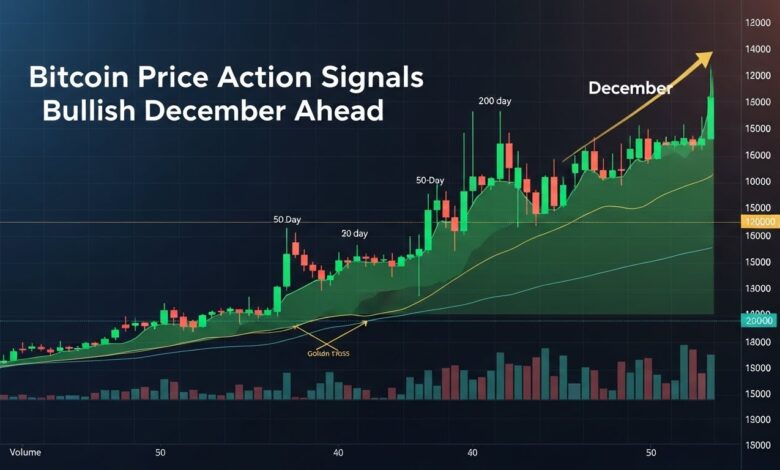
As December 2025 opens, Bitcoin price action is once again at the center of the global crypto market conversation. After printing new all-time highs above $126,000 in early October, Bitcoin has spent the past few weeks in a sharp but orderly correction, recently trading around the $92,000–$94,000 zone. Despite this pullback, Bitcoin has clawed back into slightly positive territory for the year, and the technical picture is beginning to stabilize after a volatile November that wiped more than $18,000 off the price in a single month.
Yet, price alone never tells the full story. Under the surface, investor sentiment, on-chain metrics, and macro conditions are starting to align in a way that many analysts view as constructive for a potentially bullish December. Wall Street desks, crypto-native research shops, and even large banks like JPMorgan are floating upside scenarios that see Bitcoin rallying back toward six-figure territory over the next several months.
Retail and institutional flows into Bitcoin
Underneath the headline moves, both retail and institutional behavior are shifting in ways that support a constructive December outlook.
Retail investors, who were cautious after the early-October highs, are showing signs of returning to risk assets. Trading activity in Bitcoin spot markets and ETFs tends to pick up whenever prices bounce strongly off key support zones, and the recent recovery from the $84,000–$86,000 area fits that pattern. The combination of slightly cheaper prices and improving macro expectations, particularly around interest rates, creates a fertile environment for renewed “buy the dip” behavior.
On the institutional side, ETFs, structured products, and corporate treasuries play a growing role in Bitcoin price action. BlackRock’s internal portfolios have been steadily increasing exposure to Bitcoin-linked assets, such as IBIT ETF shares, even during periods of volatility. This indicates that some large players view current levels not as a top, but as part of a broader accumulation phase.
When both retail and institutional flows lean toward cautious accumulation rather than panic selling, the market tends to form a solid base. That base often becomes the launchpad for the next leg of bullish momentum.
Derivatives, leverage and market structure
Derivatives markets are another window into the psychology behind Bitcoin price action. Elevated funding rates and deeply positive futures premiums often signal overheated optimism and excessive leverage, which can amplify downside when sentiment flips.
By contrast, the early-December pullback flushed out many over-leveraged long positions, driving a reset in funding rates and narrowing futures premiums. Such resets are uncomfortable in the moment, but they leave the market in a healthier state. With less built-up speculative leverage, there is more room for BTC price to grind higher in a more sustainable way if spot demand returns.
Options markets are also hinting at cautious optimism. Implied volatility remains elevated but is no longer exploding higher with each intraday sell-off. Skew is leaning slightly toward calls in some maturities, reflecting demand for upside exposure alongside downside protection. This mix suggests that sophisticated traders are positioning for a potential bullish December, while still respecting Bitcoin’s notorious volatility.
Historical December performance for Bitcoin
No discussion of a “bullish December” would be complete without zooming out to history. Seasonality is never a guarantee, but it can highlight recurring behavioral patterns.
From 2010 through 2024, several studies find that December has delivered average returns in the 20%–22% range for Bitcoin, often acting as a recovery month after turbulent Novembers. StatMuse data, for instance, shows strong positive Decembers such as 2011 (+55%), 2017 (+38.8%), and 2020 (+47.7%), alongside weak ones like 2013, 2014, 2018, 2021, 2022, and 2024, which saw negative returns.
In other words, December can be spectacularly bullish, but it is far from a one-way bet. The mixed distribution of returns matters: it tells us that while Bitcoin price action often benefits from year-end flows, macro shocks or overextended rallies can still derail the month.
Seasonality and year-end flows
Why does December tend to skew bullish on average? Several forces come together:
First, many traditional investors rebalance portfolios at year-end. When Bitcoin has had a strong year, even modest allocation increases from large funds can send the BTC price sharply higher because supply on exchanges is relatively thin. The same rebalancing flows can also support equities and other risk assets, reinforcing a positive feedback loop between stocks and crypto.
Second, there is a psychological and narrative component. Stories about “Santa rallies” and “year-end crypto runs” can attract speculative capital, especially from retail traders. As more people expect a bullish December, they front-run that expectation by buying earlier in the month, which can itself help power an advance.
Third, December sometimes follows a difficult November. When markets have been beaten up, any sign of stabilization can trigger short covering, renewed inflows, and a shift from fear back to cautious optimism. The current backdrop, with Bitcoin emerging from a sharp November drawdown, fits well with that pattern.
What past drawdowns tell us about rebounds
Past cycles show that sharp drawdowns within broader uptrends often precede strong relief rallies. When Bitcoin price action sells off 20%–30% from a local high but the long-term fundamentals remain intact, the market frequently stages a powerful bounce in the following weeks or months.
Several December rebounds have emerged from similar setups. For example, major pullbacks earlier in bull cycles have often been followed by aggressive recoveries once sellers were exhausted and new buyers stepped in. Historical analysis for this year points out that despite a negative November, a rebound in December remains very possible, even if not guaranteed.
The key takeaway is that while past performance does not ensure future results, the combination of a mid-cycle correction, improving sentiment, and supportive on-chain data has often been fertile ground for a bullish December.
On-chain data backing a bullish December case
Beyond price and sentiment surveys, on-chain data provides a unique window into Bitcoin’s underlying health. Instead of focusing on short-term noise, it tracks how coins actually move between wallets, exchanges, and long-term holders.
Recent analyses highlight several constructive trends. Exchange balances remain near multi-year lows as more BTC migrates into cold storage and long-term wallets, shrinking the liquid supply available to be sold on the open market. At the same time, realized price metrics and profit-and-loss indicators suggest that much of the speculative froth from the latest rally has already been washed out, with a larger share of coins now held by investors with a lower cost basis and a longer time horizon.
These patterns often precede new phases of bullish momentum, because when demand returns, there is simply less inventory for buyers to compete over.
Supply dynamics and long-term holders
One of Bitcoin’s most powerful structural forces is its fixed supply and halving cycle. Each halving reduces the flow of new coins entering circulation, amplifying the impact of Bitcoin price action driven by demand shifts.
Current on-chain data indicates that long-term holders are not distributing aggressively into the recent correction. Rather than sending coins to exchanges en masse, many “hodler” cohorts appear content to sit tight, signaling continued conviction in the long-term thesis.
When long-term holders remain steadfast and exchange balances stay low, relatively modest new inflows from ETFs, institutions, or retail buyers can push BTC price higher with outsized effect. This supply squeeze dynamic is one of the reasons analysts argue that, if sentiment turns decisively bullish, December could see a sharp move to the upside.
Network activity and adoption trends
Network metrics further strengthen the constructive narrative. Measures such as active addresses, transaction counts, and Lightning Network growth all help gauge how much real economic activity is happening on the Bitcoin network.
While some metrics softened during the November drawdown, they have not collapsed. Instead, many indicators show steady use rather than a mass exodus. At the same time, institutional adoption continues to broaden, with more banks, brokers, and payment platforms rolling out Bitcoin-related products and services.
This steady underlying adoption means that Bitcoin price action is increasingly tethered not just to speculative cycles, but also to genuine demand for Bitcoin as a macro asset, store of value, and collateral. That kind of structural support can help turn temporary sell-offs into buying opportunities.
Macro drivers supporting Bitcoin’s December outlook
Macro conditions are crucial for any honest discussion of a bullish December. Bitcoin has increasingly behaved like a high-beta play on global liquidity, interest rate expectations, and risk appetite.
As of early December, markets are leaning toward a more dovish stance from the Federal Reserve, with futures pricing a high probability of a quarter-point rate cut at the December 10 meeting. Lower interest rates reduce the appeal of low-yielding cash and bonds while supporting equities and alternative assets such as Bitcoin. When combined with strong corporate earnings and rising stock indices, this backdrop often encourages investors to move further out on the risk curve.
If the Fed confirms this dovish tilt or signals a clearer pivot toward easing in 2026, it could inject fresh liquidity into markets and provide another tailwind for Bitcoin price action in December and beyond.
Regulatory shifts and institutional adoption
Regulation has also moved from blanket hostility toward cautious integration. Instead of banning crypto outright, many jurisdictions are building frameworks for ETF products, custody, and tax treatment. In the United States, for instance, major banks and wealth platforms are now comfortable offering vetted Bitcoin ETPs and ETFs to clients, with clearly defined allocation guidelines.
This evolution matters for sentiment. When investors see that large institutions and regulators are slowly normalizing Bitcoin’s place in the financial system, it reduces existential risk and builds confidence that BTC price is not purely at the mercy of sudden bans or crackdowns.
That said, regulatory and political developments still present headline risk. But compared with earlier years, the overall trajectory is toward structured integration rather than wholesale rejection – a trend that supports the bullish long-term narrative even when short-term Bitcoin price action is choppy.
Key risks to the bullish December narrative
No outlook would be complete without acknowledging what could go wrong. Even with constructive Bitcoin price action and improving sentiment, several risks could derail a bullish December.
First, macro conditions could surprise the market. If inflation data reaccelerates or the Fed adopts a more hawkish tone than expected, risk assets could sell off across the board. In such an environment, Bitcoin’s high volatility might amplify losses rather than gains.
Second, idiosyncratic crypto events – such as a large exchange failure, security breach, or forced liquidation at a major corporate holder – could spook investors and drive BTC price sharply lower. Recent concerns around heavily leveraged Bitcoin treasury strategies underscore how concentrated holdings can create pockets of systemic risk
Third, sentiment can shift quickly. Just as narratives can turbo-charge rallies, they can also exaggerate declines. If December starts weakly and fails to deliver on “Santa rally” expectations, disappointed bulls might unwind positions, turning a cautious market into a more aggressive risk-off phase.
In short, while the ingredients for a bullish December are present, investors should remain aware that Bitcoin’s path is rarely smooth.
How traders and long-term investors can approach December
Given the mix of opportunity and risk, how might different types of market participants respond to current Bitcoin price action?
Short-term traders will likely focus on key technical levels such as support in the low-to-mid $80,000s and resistance near the recent range highs in the mid-$90,000s. The way price behaves at these thresholds – especially around major macro events like the Fed meeting – will provide important clues about whether a breakout or breakdown is more likely.
Swing traders may view December as a month to ride potential bullish momentum while keeping clear invalidation levels. For them, the combination of improving sentiment, constructive on-chain trends, and supportive macro conditions makes the risk-reward of carefully managed long positions more attractive than it was at October’s euphoric peak.
Long-term investors, meanwhile, can zoom out further. For those who see Bitcoin as a multi-year or multi-cycle asset, the current consolidation offers a chance to accumulate at a discount relative to recent highs, while still recognizing that further downside is possible. Many advisors suggest keeping crypto allocation modest within a diversified portfolio – often in the low single-digit percentages – to balance upside potential against volatility.
Regardless of strategy, risk management remains essential. Position sizing, time horizon, and emotional discipline matter just as much as any prediction about a bullish December.
Conclusion
Putting it all together, the evidence suggests that a constructive case for Bitcoin in December 2025 is more than just wishful thinking. Recent Bitcoin price action shows a market that has absorbed a sharp correction without breaking its broader uptrend. Sentiment is shifting from fear toward cautious optimism, supported by improving retail risk appetite, growing institutional adoption, and positive commentary from major banks.
Seasonality and history indicate that December often delivers strong returns, especially after turbulent Novembers, even if individual years can deviate significantly from the average. On-chain data points to low exchange balances, resilient long-term holders, and stable network activity, all of which support the structural bull case. Macro conditions – particularly the prospect of easier monetary policy and renewed liquidity – add another layer of potential upside.
At the same time, Bitcoin remains a highly volatile asset subject to sudden shocks, macro surprises, and narrative swings. A bullish December is plausible and even probable under current conditions, but it is not guaranteed.
For traders and investors alike, the most prudent approach is to respect both sides of the coin: recognize the compelling bullish signals in today’s Bitcoin price action and investor sentiment, while managing risk as if the market could still test lower levels before the next major leg higher.
FAQs
Q. Why is Bitcoin’s December performance considered important?
Bitcoin’s December performance attracts so much attention because past data shows that the month has often delivered strong gains following volatile autumn trading.
Q. How does investor sentiment influence Bitcoin price action?
Investor sentiment shapes how traders interpret and react to news, economic data, and technical signals. When sentiment turns optimistic, more participants are willing to buy dips, hold through volatility,
Q. What on-chain metrics are most relevant for a December outlook?
For a December outlook, analysts pay particular attention to exchange balances, long-term holder behavior, realized price indicators, and network activity.
Q. Could macroeconomic events derail a bullish December?
Yes. Macro events remain a major wild card for Bitcoin price action. If inflation data surprises to the upside or central banks signal a more aggressive stance on interest rates, risk assets could sell off sharply.
Q. Is now a good time to buy Bitcoin for the long term?
Whether now is a good time to buy Bitcoin depends on your risk tolerance, time horizon, and overall portfolio. On one hand, current Bitcoin price action reflects a significant discount from recent all-time highs, while sentiment, on-chain trends, and macro conditions are increasingly supportive of a bullish December and constructive 2026 outlook.