Bitcoin Falls 5% as Trump Tariff Moves Fuel Uncertainty
Bitcoin falls as Trump tariff uncertainty rattles crypto markets. Learn why BTC dropped 5% and what investors should watch in this volatile climate.

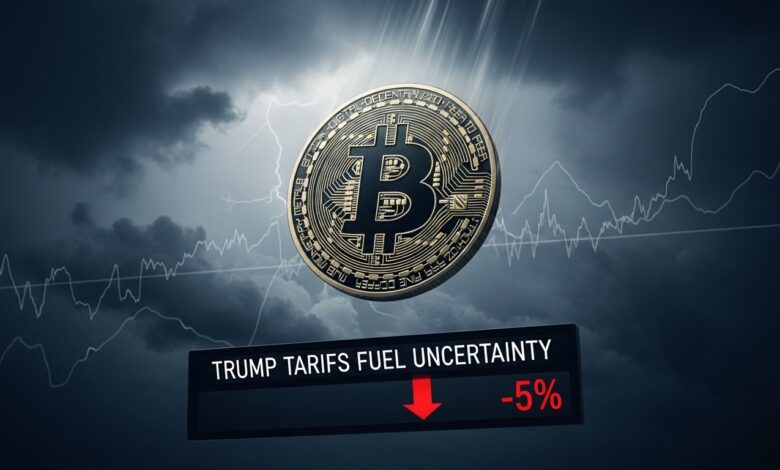
Bitcoin fell amid Trump tariff uncertainty, sending shockwaves through the digital asset space and rattling investor confidence on a global scale. In a single trading session, Bitcoin shed as much as 5% of its value — a sharp, sudden move that caught both retail traders and institutional investors off guard. The decline wasn’t born from weakness within the crypto ecosystem itself, but rather from an increasingly unpredictable macroeconomic environment driven by sweeping trade policy shifts out of Washington. When former and current U.S. presidents deploy tariff strategies that reshape global supply chains overnight, risk assets like Bitcoin are often the first to feel the pressure. This latest drop underscores how deeply intertwined cryptocurrency valuations have become with traditional financial markets and geopolitical developments — a reality today’s investors can no longer afford to ignore.
Why Bitcoin Falls as Trump Tariff Uncertainty Hits Markets
To understand this sell-off, you have to look beyond the Bitcoin chart and toward the broader financial landscape. When the Trump tariff announcements surfaced — targeting major trading partners with aggressive new import duties — global equity markets immediately reacted with fear. The S&P 500 slipped, tech stocks retreated, and commodities saw wild swings. Bitcoin, despite its reputation as a decentralized store of value, did not escape the storm.
The core problem is uncertainty. Markets don’t fear bad news nearly as much as they fear not knowing what comes next. Tariff policy, by its very nature, injects ambiguity into global trade relationships, corporate earnings projections, and inflation outlooks. When investors feel uncertain, they reduce exposure to volatile assets — and Bitcoin remains one of the most volatile assets in any portfolio.
This dynamic played out in real time as traders across Asia, Europe, and North America liquidated crypto positions to cover losses elsewhere or simply to move into safer instruments like U.S. Treasury bonds and gold. The result was a Bitcoin price drop of nearly 5%, erasing billions in market capitalization within hours.
The Relationship Between Tariff Policy and Crypto Volatility
It may seem counterintuitive that a trade policy decision would cause Bitcoin price volatility, but the connection is increasingly clear. As institutional investors — hedge funds, asset managers, and public companies — hold larger Bitcoin positions than ever before, macro events have outsized effects on crypto prices. When a pension fund sells Bitcoin to rebalance its portfolio after a tariff-induced equity crash, the selling pressure is real and immediate.
Beyond institutional mechanics, there is a psychological dimension. Retail investors, who make up a significant slice of crypto trading volume, tend to react emotionally to headlines. Trump tariff news dominates financial media, and headlines about trade wars, retaliatory duties, and economic slowdown push many everyday traders toward the exit. Fear, uncertainty, and doubt — collectively known in the crypto community as FUD — are powerful market movers.
Historical Parallels: When Trade Wars Rattle Bitcoin
This is not the first time Bitcoin has fallen during periods of trade conflict. During the height of the U.S.-China trade war in 2018 and 2019, Bitcoin experienced significant turbulence as global risk appetite collapsed. While Bitcoin eventually recovered and reached new all-time highs, those recoveries took months and sometimes years to fully materialize.
The pattern that emerges from history is telling: crypto market uncertainty tied to macro events typically causes short-to-medium term pain, followed by recovery once clarity returns. The key variable is always the duration of the uncertainty. A quick resolution to tariff disputes tends to allow crypto prices to bounce back relatively quickly. A prolonged trade war, on the other hand, can suppress sentiment for extended periods.
Investors who tracked Bitcoin during these earlier trade tensions will recognize the current market behavior. The Bitcoin sell-off we are seeing today mirrors the knee-jerk reactions of those earlier cycles — panic selling followed by a slow, cautious return of buyers looking for discounted entry points.
How Institutional Players Are Responding to Bitcoin’s Drop
Large institutional investors are approaching this Bitcoin price decline with a mixture of caution and strategic opportunity. Some firms with risk management mandates are trimming exposure to meet volatility thresholds, while others are treating the dip as a buying opportunity in a longer-term bull thesis. Publicly traded companies that hold Bitcoin on their balance sheets — a list that has grown considerably in recent years — are seeing their stock prices move in lockstep with BTC, amplifying the financial impact.
On-chain data suggests that while short-term traders are selling, long-term Bitcoin holders — often called “diamond hands” in the crypto community — are largely holding firm. This behavior is consistent with previous macro-driven dips, where experienced investors use volatility as a wealth accumulation opportunity rather than a reason to exit entirely.
Bitcoin Falls Amid Trump Tariff Moves: What the Data Shows
Looking at the technical picture, Bitcoin’s price drop pushed the leading cryptocurrency below several key support levels that traders had been watching closely. The move triggered a wave of automated liquidations in the futures market, as leveraged long positions were forcibly closed, adding further selling pressure to an already stressed market.
Trading volumes spiked significantly during the sell-off — a sign that this was not a low-liquidity event but a genuine expression of market-wide fear. Crypto market volatility indicators, such as the Bitcoin Fear and Greed Index, plunged from “Greed” territory into “Fear” within the span of just a few hours, illustrating how rapidly sentiment shifted.
Altcoins suffered even more severe losses, as they typically do when Bitcoin experiences sharp corrections. Ethereum, Solana, and other major tokens dropped between 7% and 12% during the same window, confirming that the entire digital asset market was caught in the same macro downdraft.
Key Support Levels to Watch as Bitcoin Navigates Uncertainty
Technical analysts are now closely watching several price levels that could determine whether this decline deepens or stabilizes. Bitcoin’s ability to hold its 200-day moving average has historically been a critical indicator of long-term trend health. A sustained break below this level would signal more significant trouble ahead, while a recovery above it would suggest the dip was a buying opportunity within an intact uptrend.
The broader context of cryptocurrency market conditions remains important here. If trade tensions escalate further, central banks respond by tightening monetary policy, or if other risk assets continue to decline, Bitcoin may struggle to find a floor in the near term. Conversely, any signs of trade deal negotiations or tariff rollbacks could quickly reverse sentiment.
The Macroeconomic Backdrop Driving Crypto Uncertainty
The Trump tariff impact on Bitcoin does not exist in isolation. It is part of a much larger macroeconomic narrative that has been unfolding throughout the year. Inflation remains a persistent concern in many economies, central banks are navigating a difficult path between supporting growth and taming price pressures, and geopolitical tensions in multiple regions are adding layers of complexity to an already uncertain environment.
Tariffs, at their core, are inflationary. They raise the cost of imported goods, which filters through supply chains and ultimately hits consumers and businesses. When inflation expectations rise, the Federal Reserve and other central banks face pressure to raise interest rates or maintain restrictive monetary policy for longer. Higher interest rates reduce the attractiveness of non-yielding assets like Bitcoin and cryptocurrency, as investors can earn meaningful returns simply by holding government bonds.
This monetary policy dynamic is one of the most powerful forces acting on Bitcoin’s price today. The intersection of tariff-driven inflation fears and central bank policy responses creates a challenging environment for risk assets across the board — and crypto sits at the high-risk end of that spectrum.
Dollar Strength and Its Effect on Bitcoin Prices
Another consequence of Trump trade policy uncertainty is the impact on the U.S. dollar. When investors seek safety during periods of market stress, they often flock to the dollar, driving its value higher relative to other currencies. A stronger dollar has historically been associated with weaker Bitcoin prices, as much of global crypto trading is denominated in USD.
This currency dynamic adds another layer of pressure on Bitcoin during tariff-driven uncertainty periods. Crypto investors must therefore monitor not just the policy announcements themselves but also the downstream effects on currency markets, bond yields, and global risk appetite.
Long-Term Outlook: Will Bitcoin Recover After Trump Tariff Shock?
Despite the short-term pain, many long-term Bitcoin advocates view tariff-driven market volatility as a temporary headwind rather than a structural threat to Bitcoin’s value proposition. The fundamental case for Bitcoin — its fixed supply, decentralization, and resistance to government manipulation — remains intact regardless of trade policy decisions in Washington.
Historical data consistently shows that Bitcoin has recovered from macro-driven selloffs and gone on to reach new all-time highs. The Bitcoin price recovery following each major correction has been driven by a combination of increased adoption, improving infrastructure, growing institutional participation, and eventually, a return of favorable macro conditions.
What changes with each cycle is the composition of the Bitcoin holder base. Today, more institutional money is involved than ever before. This creates both greater volatility during risk-off events (because institutional investors are more reactive to macro signals) and greater resilience over time (because institutional holders tend to have longer time horizons and deeper pockets).
What Investors Should Do During Bitcoin’s Tariff-Driven Decline
For investors currently navigating this Bitcoin market downturn, financial professionals generally emphasize the importance of sticking to a predetermined investment strategy rather than making reactive decisions based on short-term headlines. Dollar-cost averaging — the practice of buying a fixed dollar amount of Bitcoin at regular intervals regardless of price — is one approach that has historically rewarded patient investors.
Risk management is equally important. Investors with leveraged positions should be particularly cautious during periods of heightened crypto volatility, as liquidations can amplify losses significantly. Maintaining adequate cash reserves to take advantage of potential buying opportunities is another strategy that experienced crypto investors often employ during macro-driven dips.
Conclusion
The fact that Bitcoin falls as Trump tariff uncertainty escalates is a powerful reminder that cryptocurrency, for all its revolutionary potential, does not exist in a vacuum. It is inextricably linked to the broader global financial system, sensitive to macroeconomic policy shifts, and increasingly correlated with traditional risk assets during periods of market stress. Understanding these dynamics is not optional for today’s crypto investor — it is essential.
The current Bitcoin price decline driven by tariff-related uncertainty may very well prove to be a buying opportunity for patient, long-term investors who understand Bitcoin’s fundamental value proposition. The same macro forces that are pushing prices down today could reverse sharply if trade tensions ease, monetary policy pivots, or global risk appetite returns.
If you are monitoring Bitcoin’s response to Trump tariff news and want to position yourself wisely, the most important steps are to stay informed, manage risk carefully, avoid emotional decision-making, and maintain a long-term perspective. The volatility is real — but so is Bitcoin’s track record of resilience. Do your research, consult with a qualified financial advisor before making any investment decisions, and never invest more than you can afford to lose in volatile assets like cryptocurrency.
See more;American Bitcoin Share Lock-Up: Recovery After 40% Drop