Altseason Index Hits 2025 High: Altcoins Near Record Cap
Altseason Index hits 2025 high as altcoin market cap approaches all-time records. Discover which cryptocurrencies are leading the rally.

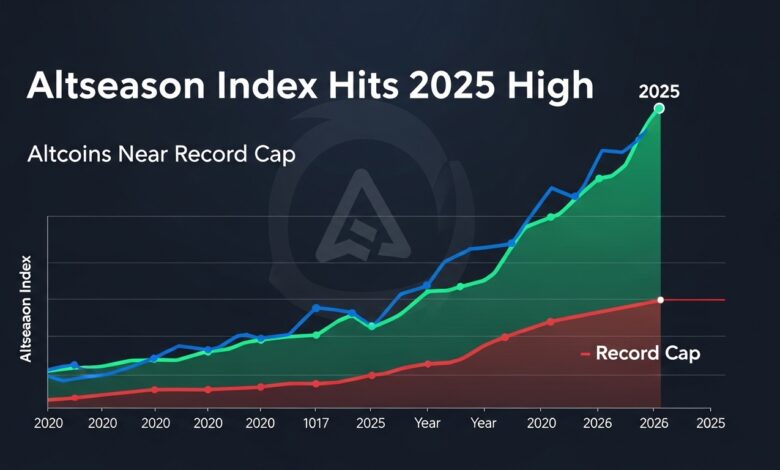
Altseason Index hits 2025 high, signaling a potential paradigm shift in digital asset performance. Alternative cryptocurrencies, commonly known as altcoins, are demonstrating remarkable strength across multiple metrics, with their collective market capitalization approaching historical record levels. This unprecedented movement has captured the attention of institutional investors, retail traders, and market analysts who are closely monitoring whether this surge represents the beginning of a sustained altcoin rally or merely a temporary deviation from Bitcoin’s traditional dominance.
The current altseason index reading suggests that alternative cryptocurrencies are significantly outperforming Bitcoin across various timeframes, a phenomenon that historically precedes major wealth redistribution events within the crypto ecosystem. As the altcoin market cap climbs toward its all-time high, understanding the underlying dynamics driving this movement becomes crucial for anyone seeking to navigate the evolving landscape of digital assets.
the Altseason Index and Its 2025 Milestone
The Altseason Index hits 2025 high represents more than just a numerical milestone; it reflects a fundamental recalibration of market sentiment and capital flows within the cryptocurrency ecosystem. This proprietary metric, developed by blockchain analytics platforms, measures the relative performance of the top 100 alternative cryptocurrencies against Bitcoin over specific timeframes ranging from one month to one year. When the index surpasses the 75-point threshold, market participants generally acknowledge that an altseason is underway, meaning that the majority of tracked altcoins are delivering superior returns compared to Bitcoin.
The recent surge to unprecedented 2025 levels indicates that approximately 75 to 85 percent of the top 100 cryptocurrencies have outperformed Bitcoin over the past 90 days, a statistical achievement that historically occurs only during specific phases of the market cycle. This phenomenon typically emerges when Bitcoin consolidates after a substantial rally, allowing alternative cryptocurrencies to capture investor attention and capital that seeks higher risk-adjusted returns. The psychological shift from Bitcoin maximalism to altcoin speculation often accelerates once retail investors observe consistent gains across multiple digital assets, creating a self-reinforcing cycle of capital rotation.
Market analysts emphasize that the altseason index serves as a valuable tool for timing market entries and exits, though it should never be used in isolation. The current elevated readings coincide with several technical and fundamental factors that suggest the cryptocurrency altseason may have substantial runway ahead. Historical patterns demonstrate that once the index breaches certain thresholds, the momentum can sustain for several months before reverting to Bitcoin dominance, providing strategic opportunities for informed market participants.
Altcoin Market Cap Approaches Historical Records
The altcoin market cap has experienced explosive growth throughout early 2025, climbing from approximately 850 billion dollars in January to surpassing 1.2 trillion dollars by mid-February. This remarkable expansion represents a growth rate exceeding 40 percent within a compressed timeframe, signaling robust demand for alternative cryptocurrencies across multiple sectors including decentralized finance, layer-one protocols, artificial intelligence tokens, and real-world asset tokenization platforms. The approaching proximity to the all-time high market capitalization recorded during the previous cycle has generated considerable excitement and speculation about whether this rally possesses the fundamental strength to establish new records.
Several factors distinguish the current altcoin rally from previous market cycles. Institutional adoption has matured significantly, with traditional finance entities increasingly allocating portions of their digital asset portfolios beyond Bitcoin and Ethereum. Regulatory clarity in major jurisdictions has reduced uncertainty premiums that previously suppressed altcoin valuations, while technological advancements in scalability and interoperability have enhanced the practical utility of numerous blockchain networks. The convergence of these developments has created an environment where altcoins near record market cap levels are supported by genuine fundamental improvements rather than speculative fervor alone.
The composition of the altcoin market cap has also evolved considerably compared to previous cycles. While Ethereum continues to command the largest share among alternative cryptocurrencies, emerging layer-one solutions, decentralized exchange protocols, and blockchain infrastructure projects have collectively captured substantial market share. This diversification suggests a maturing ecosystem where value is distributed across multiple use cases rather than concentrated in a handful of dominant players, potentially indicating a more sustainable foundation for continued growth.
Key Drivers Behind the Altseason Surge
Multiple confluent factors have contributed to the Altseason Index hits 2025 high phenomenon, creating a perfect storm of technical, fundamental, and macroeconomic conditions favorable to alternative cryptocurrencies. Understanding these drivers provides essential context for evaluating the sustainability and potential trajectory of the current market movement.
Bitcoin consolidation has emerged as perhaps the most immediate catalyst for the altcoin rally. After Bitcoin reached new all-time highs earlier in 2025, the cryptocurrency entered a phase of range-bound trading that persisted for several weeks. This consolidation period historically triggers capital rotation as traders and investors seek opportunities in assets demonstrating stronger price momentum. The psychological shift from Bitcoin accumulation to altcoin speculation accelerates when market participants perceive that Bitcoin’s near-term upside potential has temporarily plateaued, directing speculative capital toward higher-beta alternatives.
Institutional capital deployment into alternative cryptocurrencies has reached unprecedented levels during this cycle. Major asset managers and family offices that initially confined their crypto allocations to Bitcoin and Ethereum have expanded their mandates to include carefully selected altcoins with strong fundamentals and proven use cases. This institutional validation has reduced the stigma previously associated with altcoin investments, attracting additional capital from sophisticated investors who previously remained skeptical about cryptocurrencies beyond the top two market leaders.
Regulatory developments have significantly impacted the cryptocurrency altseason dynamics. The approval of spot Bitcoin exchange-traded funds in the United States during late 2024 created a blueprint for similar products focusing on alternative cryptocurrencies. Anticipation of spot Ethereum ETF options and potential future approvals for other major altcoins has generated substantial speculative interest, as investors position themselves ahead of anticipated institutional inflows. Regulatory clarity regarding token classifications and securities law applications has also reduced legal uncertainty that previously suppressed valuations across numerous projects.
Technological Innovation Fueling Altcoin Performance
The current phase where altcoins near record market cap levels is distinguished by genuine technological advancement rather than purely speculative dynamics. Layer-one blockchain protocols have achieved significant breakthroughs in scalability, processing thousands of transactions per second while maintaining decentralization and security properties that rival or exceed traditional financial infrastructure. These improvements have enabled practical applications previously constrained by technical limitations, expanding the addressable market for blockchain-based solutions.
Decentralized finance protocols have evolved considerably, introducing sophisticated financial instruments that mirror traditional finance products while maintaining the permissionless and transparent characteristics inherent to blockchain technology. The total value locked in DeFi protocols has surged alongside the broader altcoin market cap, demonstrating that capital flowing into these ecosystems is actively deployed rather than merely held speculatively. Revenue-generating protocols with established business models have attracted particular attention from fundamental-focused investors seeking digital assets with intrinsic value beyond pure speculation.
Artificial intelligence integration with blockchain technology has emerged as a dominant narrative driving performance among specific alternative cryptocurrencies. Projects focusing on decentralized AI computation, machine learning model training on distributed networks, and AI-powered blockchain analytics have experienced extraordinary growth as investors anticipate the convergence of two transformative technology paradigms. The intersection of AI and blockchain represents a greenfield opportunity that has captured imagination and capital from both cryptocurrency natives and traditional technology investors.
Bitcoin Dominance Decline Signals Market Rotation
The Bitcoin dominance metric, which measures Bitcoin’s market capitalization as a percentage of the total cryptocurrency market cap, has declined significantly as the Altseason Index hits 2025 high. This inverse relationship between Bitcoin dominance and altcoin performance represents one of the most reliable indicators for identifying cryptocurrency altseason periods. Current readings show Bitcoin dominance falling from approximately 58 percent in early January to below 52 percent by mid-February, a substantial shift indicating aggressive capital rotation into alternative cryptocurrencies.
Historical analysis reveals that Bitcoin dominance typically follows cyclical patterns closely correlated with broader market sentiment and investor risk appetite. During periods of market uncertainty or bearish conditions, Bitcoin dominance tends to increase as investors seek relative safety in the most liquid and established cryptocurrency. Conversely, when market confidence strengthens and risk appetite expands, dominance declines as capital flows into higher-beta altcoins offering superior short-term return potential. The current dominance trajectory suggests that market participants have entered a risk-on phase characterized by growth-seeking behavior rather than capital preservation.
The pace of Bitcoin dominance decline serves as a crucial indicator for assessing altcoin rally sustainability. Gradual, measured declines typically indicate healthy market rotation supported by fundamental improvements across the altcoin ecosystem, whereas rapid, precipitous drops often signal speculative excess vulnerable to sharp corrections. The current decline rate falls within historical norms for sustainable altseason periods, suggesting the movement may possess sufficient fundamental support to continue for an extended period before reverting to Bitcoin dominance expansion.
Top Performing Altcoins Leading the Rally
Specific alternative cryptocurrencies have demonstrated exceptional performance during this phase where the altcoin market cap approaches record levels. Layer-one blockchain protocols focusing on scalability and developer-friendly environments have captured substantial market share, with several projects experiencing triple-digit percentage gains since the beginning of 2025. These platforms have benefited from increasing developer activity, growing transaction volumes, and expanding ecosystems of applications built on their infrastructure.
Decentralized exchange tokens and decentralized finance protocols have similarly experienced remarkable appreciation as trading volumes across DEX platforms reach new records. The shift from centralized to decentralized trading venues has accelerated following high-profile exchange failures and regulatory scrutiny of centralized entities, driving both trading activity and token appreciation for leading protocols. Revenue-sharing mechanisms that distribute trading fees to token holders have attracted fundamental investors seeking yield-generating digital assets beyond pure price speculation.
Real-world asset tokenization platforms represent another category experiencing significant growth during the cryptocurrency altseason. Projects enabling the tokenization of traditional assets including real estate, commodities, and corporate debt have attracted attention from both cryptocurrency investors and traditional finance institutions exploring blockchain applications. The regulatory clarity emerging around security token frameworks has reduced compliance uncertainty, enabling these projects to expand operations and attract institutional capital previously sidelined by legal ambiguity.
Market Cycle Positioning and Historical Patterns
Understanding where the current altcoin rally sits within the broader market cycle provides essential context for evaluating potential trajectories and risk management considerations. Historical cryptocurrency market cycles have typically followed four-year patterns aligned with Bitcoin halving events, though the increasing market maturity and institutional participation may disrupt these historical rhythms. The most recent Bitcoin halving occurred in April 2024, placing the current market approximately ten months post-halving, a period that historically corresponds with accelerating altcoin performance.
Previous cycles demonstrate that cryptocurrency altseason periods typically emerge six to eighteen months following Bitcoin halvings, coinciding with Bitcoin price consolidation after initial post-halving rallies. The current market positioning aligns remarkably with these historical patterns, suggesting the Altseason Index hits 2025 high may represent the early or middle stages of a sustained period of altcoin outperformance rather than a temporary aberration. However, market participants must recognize that historical patterns provide probabilistic frameworks rather than deterministic predictions, as evolving market structure and participant composition continuously reshape cycle dynamics.
The duration and magnitude of previous altseason periods offer instructive benchmarks for current expectations. The 2017 altseason witnessed several months of sustained altcoin outperformance with the altcoin market cap expanding by multiples before eventually correcting. The 2020-2021 cycle similarly demonstrated extended periods where alternative cryptocurrencies substantially outperformed Bitcoin, though with different sectoral leadership and narrative drivers. Current market conditions exhibit characteristics of both previous cycles while introducing novel elements including institutional participation and regulatory clarity that may extend or moderate traditional cycle patterns.
Risk Factors and Potential Headwinds
Despite the optimistic sentiment surrounding the altcoin rally and the Altseason Index hits 2025 high milestone, numerous risk factors could disrupt the current trajectory and trigger market corrections. Macroeconomic conditions remain uncertain, with central bank monetary policy, inflation dynamics, and global growth prospects all potentially impacting cryptocurrency valuations. A deterioration in risk appetite across broader financial markets would likely trigger capital outflows from speculative assets including alternative cryptocurrencies, potentially reversing recent gains rapidly.
Regulatory developments present both opportunities and risks for the altcoin market cap trajectory. While regulatory clarity has generally supported market growth, the potential for restrictive regulations targeting specific cryptocurrency categories remains a persistent concern. Enforcement actions against projects classified as securities, restrictions on decentralized finance protocols, or prohibitions on certain cryptocurrency activities could significantly impact valuations and market sentiment. The regulatory landscape continues evolving globally, creating ongoing uncertainty that may periodically disrupt market momentum.
Technical vulnerabilities and security incidents represent another category of risk potentially impacting the cryptocurrency altseason. Smart contract exploits, bridge hacks, and protocol vulnerabilities have historically triggered significant market corrections when they affect major projects or result in substantial capital losses. The increasing complexity of decentralized applications and cross-chain interactions expands the attack surface for malicious actors, requiring continuous vigilance from both project teams and investors. A major security incident affecting a prominent altcoin could trigger contagion effects across the broader ecosystem, temporarily halting the current rally.
Strategic Considerations for Market Participants
Navigating the environment where altcoins near record market cap levels requires sophisticated strategic frameworks balancing opportunity capture with prudent risk management. Diversification across multiple alternative cryptocurrencies representing different sectors and use cases can mitigate project-specific risks while maintaining exposure to the broader altcoin rally. Concentration in single projects or narrow sectors amplifies both potential returns and potential losses, requiring careful consideration of individual risk tolerance and investment objectives.
Position sizing becomes critically important during elevated market conditions when the Altseason Index hits 2025 high readings. Historical volatility patterns demonstrate that altcoin valuations can experience substantial corrections even within broader uptrends, requiring position sizes calibrated to withstand temporary drawdowns without forcing capitulation at inopportune moments. Employing disciplined position sizing based on portfolio percentage allocations rather than absolute dollar amounts helps maintain consistent risk exposure across varying market conditions.
Profit-taking strategies warrant careful consideration as the altcoin market cap approaches historical records. Systematic partial profit realization at predetermined price targets can lock in gains while maintaining exposure to continued upside potential. The psychological challenge of exiting winning positions before exhausting upward momentum must be balanced against the risk of riding positions through major corrections that eliminate substantial paper profits. Establishing clear exit criteria based on technical indicators, fundamental developments, or portfolio allocation targets before entering positions helps overcome emotional decision-making during volatile market conditions.
Future Outlook and Potential Catalysts
The trajectory of alternative cryptocurrencies beyond the current Altseason Index hits 2025 high milestone depends on numerous evolving factors including macroeconomic conditions, regulatory developments, technological advancement, and market sentiment dynamics. Several potential catalysts could extend and amplify the current cryptocurrency altseason, including the approval of additional cryptocurrency exchange-traded funds, major institutional adoption announcements, or breakthrough technological developments expanding blockchain utility.
The maturation of real-world blockchain applications beyond speculative trading could fundamentally expand the addressable market for altcoins near record market cap levels. Supply chain tracking, digital identity verification, tokenized securities trading, and decentralized social media platforms all represent use cases with substantial total addressable markets that could justify significant market capitalizations if adoption accelerates. The transition from speculative assets to utility-generating platforms would represent a paradigm shift supporting sustained altcoin market cap growth beyond traditional cycle patterns.
Conversely, various scenarios could truncate the current altcoin rally and trigger renewed Bitcoin dominance expansion. Deteriorating macroeconomic conditions, restrictive regulatory developments, major security incidents, or technical failures affecting prominent projects could all trigger risk-off behavior favoring Bitcoin over alternative cryptocurrencies. The probability and timing of such scenarios remain inherently uncertain, requiring continuous monitoring of market conditions and willingness to adjust positioning as circumstances evolve.
Conclusion
The Altseason Index hits 2025 high represents a significant milestone reflecting genuine shifts in cryptocurrency market dynamics, capital flows, and investor sentiment. As altcoins near record market cap levels supported by technological advancement, institutional adoption, and improving regulatory clarity, market participants face both substantial opportunities and meaningful risks. The current environment rewards informed, disciplined approaches combining fundamental analysis, technical evaluation, and prudent risk management rather than purely speculative positioning.
Understanding that cryptocurrency altseason periods are cyclical phenomena helps maintain perspective during both euphoric uptrends and inevitable corrections. The alternative cryptocurrencies demonstrating sustainable value creation through genuine utility, growing ecosystems, and sound tokenomics are most likely to weather market volatility and deliver long-term value beyond short-term price appreciation. As the altcoin market cap continues evolving, staying informed about market developments, maintaining disciplined strategies, and managing risk appropriately will separate successful participants from those caught unprepared by market reversals.
For investors seeking to capitalize on the Altseason Index hits 2025 high phenomenon, continuous education, selective positioning in fundamentally sound projects, and disciplined risk management provide the foundation for navigating this dynamic and rapidly evolving market. The current altcoin rally may continue for weeks or months ahead, but maintaining the flexibility to adapt as conditions change remains essential for long-term success in cryptocurrency markets.
See more;