XRP Price News: Exchange Inflows Spike as Whales Sell at $1.55
XRP price faces pressure as exchange inflows spike. Discover why whales are loading up to sell at $1.55 and what it means for investors.

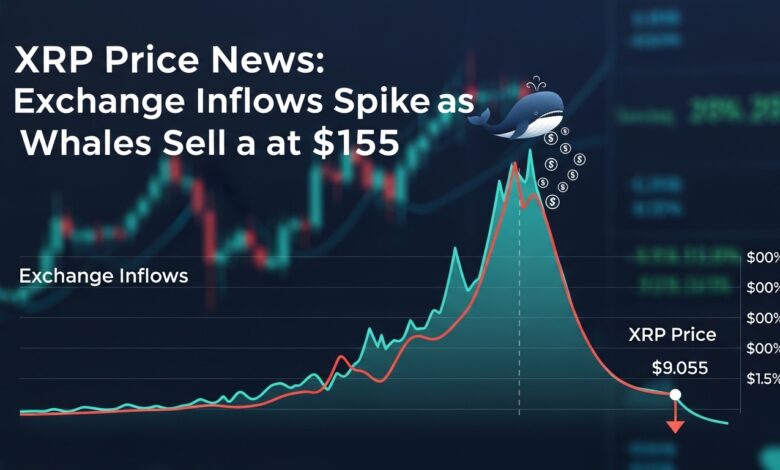
XRP price exchange inflows have experienced a notable surge, signaling potential volatility ahead as large-scale investors position themselves for strategic exits. With whale wallets moving substantial amounts of tokens to trading platforms and the critical $1.55 price level emerging as a key resistance zone, market participants are closely monitoring these movements to gauge the short-term trajectory of this digital asset. Understanding the dynamics behind these exchange inflows and whale behavior becomes essential for anyone holding or considering positions in XRP during this pivotal moment.
The relationship between XRP price movements and on-chain metrics has always provided valuable insights into market sentiment. When large holders, commonly referred to as whales, begin transferring significant quantities of tokens to exchanges, it typically suggests preparation for selling activity. This pattern has emerged once again, creating waves of speculation throughout the cryptocurrency community about whether XRP can maintain its recent gains or if a correction looms on the horizon.
XRP Exchange Inflow Phenomenon
Exchange inflows represent one of the most critical on-chain metrics for analyzing cryptocurrency market behavior. When investors transfer their holdings from private wallets to exchange platforms, it generally indicates an intention to sell or trade those assets. The recent spike in XRP exchange inflows has raised eyebrows across the trading community, particularly given the timing and volume of these transfers.
Data from blockchain analytics platforms reveals that over the past week, exchanges have witnessed deposits totaling hundreds of millions of XRP tokens. This substantial movement represents a significant shift from the accumulation pattern observed in previous months. The correlation between increased exchange deposits and subsequent price action has historically been negative for XRP price performance, as selling pressure tends to outweigh buying demand when supply on exchanges increases dramatically.
The mechanics behind this phenomenon are straightforward yet impactful. When whales hold their XRP in cold storage or private wallets, those tokens are effectively removed from the circulating supply available for immediate trading. However, once transferred to exchanges, these tokens become part of the readily available supply, potentially creating downward pressure on prices if buyers cannot absorb the increased selling volume.
Market analysts have noted that the current exchange inflow pattern differs slightly from previous cycles. Rather than a gradual increase, the deposits have occurred in concentrated bursts, suggesting coordinated activity among multiple large holders. This coordinated movement amplifies the potential impact on XRP price dynamics, as simultaneous selling from multiple whales can overwhelm buy-side liquidity more effectively than staggered distributions.
Whale Activity and Market Implications
Blockchain forensics indicate that several wallets holding between five million and fifty million XRP tokens have become active after months of dormancy. These movements suggest that long-term holders are taking profits or repositioning their portfolios in response to recent market conditions. The psychological impact of whale selling cannot be understated, as retail investors often interpret these movements as bearish signals, potentially triggering cascading sell orders.
The motivation behind whale behavior varies considerably. Some large holders may be rebalancing their portfolios after the recent Ripple price appreciation, while others might be responding to regulatory developments or macroeconomic factors affecting the broader cryptocurrency market. Regardless of the specific catalysts, the practical effect remains the same: increased supply on exchanges creates potential selling pressure that the market must absorb to maintain current price levels.
Historical analysis of XRP whale movements reveals interesting patterns. Previous instances of substantial exchange deposits have often preceded price corrections ranging from five to fifteen percent within the following two weeks. However, not all whale movements result in immediate selling. Some sophisticated investors transfer tokens to exchanges to provide liquidity for lending platforms or to prepare for potential buying opportunities during anticipated market dips.
The current situation presents a nuanced picture. While the volume of exchange inflows certainly warrants attention, the XRP price has demonstrated remarkable resilience in the face of this increased supply. This resilience suggests that buyer demand remains robust enough to absorb at least a portion of the potential selling pressure, though the critical test will come if whales actually execute large market sell orders rather than placing limit orders at higher price points.
The Critical $1.55 Resistance Level
The $1.55 resistance level coincides with several technical factors that reinforce its significance. First, this zone represents a previous consolidation area where significant trading volume occurred during earlier price cycles. When prices return to these historically relevant levels, they often encounter resistance as previous buyers who entered at these levels look to exit at breakeven or modest profits. Additionally, the $1.55 mark aligns closely with key Fibonacci retracement levels derived from recent price swings, adding another layer of technical importance.
From a whale perspective, targeting $1.55 for strategic selling makes considerable sense. This price level offers an attractive profit-taking opportunity for investors who accumulated XRP at lower levels throughout the previous bear market. For whales who purchased tokens between $0.40 and $0.60, selling at $1.55 represents gains of one hundred fifty to two hundred eighty percent, a compelling return by any standard.
The concentration of sell orders at this resistance level creates a self-fulfilling prophecy effect. As more traders identify $1.55 as a critical zone, they place their own sell orders nearby, creating a thick wall of supply that becomes increasingly difficult to penetrate. This clustering effect explains why XRP price has struggled to achieve a decisive breakout despite multiple attempts.
Market depth analysis from major exchanges confirms the presence of substantial sell-side liquidity clustered between $1.52 and $1.58. This concentration represents millions of dollars worth of XRP tokens waiting to be sold, creating a significant challenge for any bullish momentum attempting to push prices higher. Breaking through this resistance would require exceptional buying volume that currently appears absent from the market.
Market Sentiment and Broader Cryptocurrency Trends
Bitcoin and Ethereum, the two largest cryptocurrencies by market capitalization, have both exhibited choppy price action that creates ripple effects throughout the altcoin market. When major assets struggle to establish clear directional trends, traders often become more cautious with positions in smaller-cap tokens like XRP, preferring to reduce exposure and preserve capital. This risk-off sentiment can amplify the impact of whale selling as retail participants rush to exit positions before potential downside materializes.
Regulatory news continues to shape Ripple and XRP market dynamics. Recent developments in the ongoing legal proceedings and regulatory clarity initiatives have created both opportunities and uncertainties for token holders. Some whales may be interpreting recent news as a favorable exit point, choosing to realize gains while regulatory outcomes remain in flux rather than risking potential adverse developments that could impact prices negatively.
The broader economic environment also plays a crucial role. Rising interest rates, inflation concerns, and geopolitical tensions have historically correlated with reduced risk appetite among investors. In such environments, cryptocurrency assets often experience outflows as capital seeks perceived safety in traditional assets or stable holdings. The current exchange inflow spike for XRP aligns with this pattern of de-risking across the digital asset sector.
Social media sentiment analysis reveals mixed signals regarding XRP price expectations. While some community members remain bullish on long-term prospects, citing technological developments and expanding use cases, others express concern about near-term headwinds created by whale distribution. This divergence in opinion creates market uncertainty that can exacerbate volatility when large holders execute significant trades.
Technical Analysis and Price Projections
Key technical indicators provide mixed signals about XRP price direction. The Relative Strength Index currently hovers in neutral territory, suggesting neither overbought nor oversold conditions. This neutral reading indicates that the market has room to move in either direction without immediately triggering technical reversals. However, momentum indicators have begun showing slight bearish divergences, where price makes higher highs while the indicator fails to confirm, often a warning sign of weakening bullish momentum.
Moving averages tell an interesting story. XRP price currently trades above its fifty-day moving average but struggles to reclaim the two-hundred-day moving average convincingly. This positioning suggests a market in transition, where longer-term trend determination remains uncertain. A decisive move above $1.55 would likely signal continuation of the medium-term uptrend, while failure to break resistance could result in a retracement toward support levels around $1.35 or lower.
Volume analysis adds another dimension to the technical picture. Recent trading sessions have shown declining volume as price approaches the $1.55 resistance, a pattern that often indicates weakening buying conviction. For a legitimate breakout to occur, technical analysts typically want to see expanding volume accompanying upward price movement, confirming genuine demand rather than short-covering or low-conviction buying.
The implications of current exchange inflows become clearer when viewed through this technical framework. If whales begin executing sell orders while XRP remains beneath $1.55 resistance, the path of least resistance appears to be downward toward established support zones. Conversely, if buyers can absorb the incoming supply and generate enough momentum to break $1.55, it could trigger short squeeze dynamics and momentum-based buying that propels prices toward the next resistance level near $1.75 to $1.80.
Strategic Considerations for XRP Investors
For long-term holders who believe in Ripple’s fundamental value proposition and technological capabilities, current whale selling may represent temporary noise rather than a fundamental shift in the asset’s prospects. These investors might view any price weakness resulting from near-term selling pressure as potential accumulation opportunities, particularly if prices retreat to more attractive entry points below $1.40 or $1.30.
Short-term traders face a more complex decision matrix. The elevated risk of downside volatility stemming from potential whale distribution argues for caution and tight risk management. Traders might consider reducing position sizes, implementing stop-loss orders, or even taking profits at current levels to preserve gains achieved during recent XRP price appreciation. The old trading adage about not fighting whale movements certainly applies in this situation.
Portfolio diversification becomes particularly important during periods of elevated token-specific risk. Investors heavily concentrated in XRP might consider rebalancing toward other cryptocurrency assets or even traditional holdings to reduce exposure to potential adverse price movements. This diversification doesn’t necessarily reflect bearish sentiment on XRP but rather represents prudent risk management in uncertain conditions.
The importance of monitoring on-chain metrics cannot be overstated. Investors should track exchange inflow and outflow data regularly, as changes in these patterns often precede shifts in price trends. If exchange inflows begin to decrease or reverse, it could signal that whale distribution has concluded, potentially clearing the path for renewed appreciation. Conversely, continued or accelerating inflows would suggest that selling pressure may persist, warranting continued caution.
Educational resources and market analysis tools have never been more accessible for cryptocurrency investors. Taking time to understand blockchain analytics, technical analysis principles, and whale behavior patterns empowers better decision-making. Investors who develop these skills can interpret market signals more effectively and avoid emotional reactions to short-term volatility that often result in suboptimal outcomes.
Historical Context and Precedent Analysis
More recently, during the 2021 bull market, XRP encountered similar dynamics when approaching the $2.00 level. Exchange inflows spiked as the token neared this psychological and technical barrier, and subsequent whale selling contributed to a correction that pushed prices back below $1.50 for several months. However, it’s important to note that broader market conditions, including Bitcoin’s trajectory and regulatory concerns specific to Ripple, also influenced those outcomes significantly.
Not all historical episodes of elevated exchange inflows resulted in immediate or severe price declines. Some instances saw XRP consolidate for extended periods while absorbing whale distribution gradually, ultimately resuming upward trends once selling pressure diminished. These historical precedents remind us that while whale movements warrant attention, they don’t guarantee specific outcomes, particularly when buyer demand remains robust.
The duration of whale distribution phases has varied considerably across different cycles. Some selling waves concluded within two to four weeks, while others extended for several months as large holders distributed positions gradually to minimize market impact. The pacing and execution strategy employed by current whales will significantly influence how XRP price responds in coming weeks.
Comparing current on-chain metrics to historical episodes reveals both similarities and differences. The absolute volume of exchange inflows relative to total circulating supply appears elevated but not unprecedented. What stands out in the current situation is the concentration of deposits within a relatively short timeframe, suggesting more urgency or coordination among whale participants than observed in some previous distribution events.
Conclusion
The convergence of spiking XRP price exchange inflows, concentrated whale activity, and the formidable $1.55 resistance level creates a pivotal moment for Ripple’s native token. Investors and traders must carefully assess these dynamics while maintaining perspective on both short-term technical factors and longer-term fundamental considerations that drive cryptocurrency valuations.
The data clearly indicates that large holders are positioning themselves for potential exits, transferring substantial quantities of XRP to exchanges in preparation for selling activity. Whether this distribution occurs through aggressive market orders or more measured limit order placement will significantly impact near-term price volatility. The $1.55 level represents the critical battleground where bulls and bears will determine the next directional move for this digital asset.
For those holding XRP or considering positions, the current environment demands heightened vigilance and disciplined risk management. Monitoring exchange inflow trends, volume patterns, and price behavior around key technical levels provides the information necessary to make informed decisions aligned with individual investment objectives and risk tolerance.
As the Ripple ecosystem continues evolving and the broader cryptocurrency market navigates regulatory developments and macroeconomic headwinds, understanding whale behavior and on-chain metrics becomes increasingly valuable. The current situation with XRP price exchange inflows exemplifies why successful digital asset investing requires attention to multiple data sources beyond simple price charts.
Whether you’re a long-term believer in Ripple’s technology and use cases or a tactical trader seeking to capitalize on short-term opportunities, staying informed about XRP exchange inflows and whale movements will prove essential in the weeks ahead. Monitor these metrics closely, maintain disciplined position sizing, and be prepared to adjust strategies as market conditions evolve in this dynamic cryptocurrency landscape.
See more;Tom Lee Bitcoin $250K Price Target 2026: Bold Prediction Explained