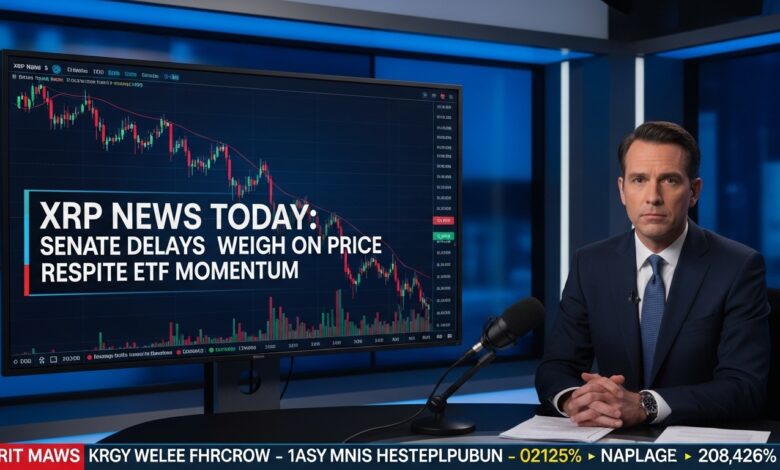
XRP News Today: Senate Delays Weigh on Price Despite ETF Momentum
XRP news today reveals Senate delays impact prices while ETF approvals create bullish momentum. Latest updates on XRP regulatory developments.

XRP news today brings a mixed bag of developments that have investors watching closely. Recent Senate procedural delays have created headwinds for Ripple’s native token, even as exchange-traded fund tailwinds promise to deliver long-term bullish catalysts. Understanding these competing forces is essential for anyone tracking XRP market analysis or considering their investment strategy in the current regulatory environment.
The digital asset landscape has transformed dramatically over the past year, with regulatory clarity becoming the primary driver of price action across major cryptocurrencies. For XRP specifically, the intersection of political developments in Washington and institutional adoption through ETF mechanisms has created a fascinating dynamic that traders and long-term holders must navigate carefully. Today’s developments underscore the complex relationship between government oversight and market sentiment in the evolving world of blockchain-based financial instruments.
Senate Delays Impacting XRP
The latest XRP news today centers around unexpected delays in the United States Senate regarding cryptocurrency legislation that many believed would provide the regulatory framework necessary for digital assets to thrive. These procedural holdups have created uncertainty in the market, leading to a weakening of XRP’s price despite otherwise favorable conditions. The delays primarily affect comprehensive crypto legislation that would establish clear guidelines for how digital assets like XRP should be classified and regulated.
Senate delays are not uncommon in the American legislative process, but their impact on cryptocurrency markets has become increasingly pronounced as institutional investors demand regulatory certainty before committing significant capital. The current holdup involves disagreements between key senators on specific provisions related to digital asset taxation, custody requirements, and the jurisdictional boundaries between the Securities and Exchange Commission and the Commodity Futures Trading Commission.
For XRP specifically, these delays matter because Ripple has positioned itself as a company eager to operate within clear regulatory boundaries. The Ripple SEC case, which concluded with a mixed outcome that found XRP sales to retail investors were not securities offerings, demonstrated the token’s unique position in regulatory discussions. However, without comprehensive legislation, the market remains vulnerable to individual enforcement actions and regulatory interpretations that can shift dramatically based on political winds.
The Senate delays have manifested in weakened price action, with XRP experiencing modest declines even as broader cryptocurrency sentiment has remained relatively stable. This divergence highlights how regulatory news specifically affects tokens that have been at the center of compliance discussions. Traders monitoring XRP price prediction models have had to adjust their algorithms to account for the extended timeline on legislative clarity, pushing some bullish scenarios further into the future.
ETF Tailwinds Creating Bullish Momentum for XRP
Despite the regulatory headwinds from Senate delays, XRP news today also includes significant positive developments around exchange-traded fund applications and approvals. Multiple asset management firms have filed applications for XRP-focused ETFs, following the successful launches of Bitcoin and Ethereum ETF products that have attracted billions in institutional capital. These filings represent a vote of confidence in XRP’s long-term viability and its differentiation from securities that would face more stringent regulatory barriers.
The XRP ETF approval process has gained momentum as the SEC has begun to establish clearer frameworks for evaluating cryptocurrency ETF applications. While approval is not guaranteed, the fact that major financial institutions are willing to navigate the regulatory process for XRP-specific products signals strong institutional interest. These ETF vehicles would provide traditional investors with exposure to XRP price movements without the complexities of direct token ownership, custody, and security considerations.
ETF tailwinds matter tremendously for cryptocurrency adoption because they lower the barrier to entry for institutional investors, retirement accounts, and traditional portfolio managers who face restrictions on directly purchasing digital assets. When Bitcoin ETFs launched, they quickly accumulated substantial assets under management, demonstrating pent-up demand for regulated cryptocurrency exposure. Similar dynamics could benefit XRP if approval processes move forward successfully.
The institutional infrastructure surrounding XRP has matured significantly, with major custody providers, prime brokers, and trading platforms adding support for the token. This infrastructure development has occurred even during the uncertainty created by the Ripple lawsuit update and subsequent regulatory ambiguity. The combination of improved infrastructure and potential ETF approval creates a foundation for sustained institutional adoption that could drive XRP price forecast scenarios higher over the medium to long term.
XRP Price Action Analysis Amid Competing Forces
Current XRP trading volume data reveals interesting patterns as market participants process the contradictory signals from Senate delays and ETF momentum. Volume has remained elevated compared to historical averages, suggesting that significant repositioning is occurring as traders reassess their outlook based on the latest developments. The price weakness has been relatively modest, indicating that many holders view current levels as attractive accumulation zones rather than signals to exit positions.
Technical analysis of XRP’s price chart shows the token testing key support levels that have historically provided rebounds during previous periods of uncertainty. The resistance levels established during earlier rallies remain intact, creating a defined trading range that has characterized XRP’s price action for several months. Breaking through these resistance zones would likely require a catalyst such as definitive XRP ETF approval or the passage of comprehensive crypto legislation that removes regulatory overhang.
The relationship between XRP price prediction and regulatory developments has become increasingly tight, with price movements often preceding or immediately following news about legislative progress or setbacks. This correlation underscores the importance of monitoring political developments in Washington for anyone trading XRP or building long-term positions. The current weakness on Senate delays fits this pattern, as does the failure to fully capitalize on positive ETF news, suggesting the market is weighing both factors simultaneously.
Comparing XRP’s current performance to other major cryptocurrencies provides additional context. While Bitcoin and Ethereum have largely shrugged off the Senate delays, focusing instead on their own catalysts, XRP’s unique regulatory history makes it more sensitive to legislation specifically targeting digital asset regulation. This sensitivity creates both risks and opportunities, as positive developments could trigger outsized moves relative to the broader crypto market.
Ripple’s Strategic Position in the Evolving Regulatory Landscape
The latest XRP news today must be understood within the context of Ripple’s broader strategic positioning as a company focused on institutional payment solutions. Ripple has consistently argued that XRP serves a utility function in facilitating cross-border transactions, distinguishing it from cryptocurrencies primarily used for speculation or value storage. This positioning has influenced how regulators and institutional investors view the token.
Ripple’s settlement with the SEC, while not providing complete regulatory clarity, established important precedents about how XRP sales should be evaluated. The court’s determination that programmatic sales to retail investors were not securities offerings was a significant victory that differentiated XRP from many other tokens that have faced regulatory action. However, the ruling also found that some institutional sales could be considered securities transactions, creating a nuanced regulatory environment that requires careful navigation.
The company’s ongoing expansion of its On-Demand Liquidity product, which uses XRP to facilitate real-time cross-border payments, demonstrates practical utility that supports the non-security argument. Financial institutions adopting this technology create organic demand for XRP that exists independently of speculative trading. This fundamental demand provides a floor for the token’s value proposition even when regulatory uncertainty creates short-term price pressures.
Ripple’s international strategy has also evolved significantly, with the company expanding operations in jurisdictions that have provided clearer regulatory frameworks for cryptocurrency regulation. Markets in Asia, the Middle East, and Europe have seen increased Ripple activity as the company positions itself to serve global payment corridors regardless of U.S. regulatory timelines. This geographic diversification reduces reliance on American regulatory developments while maintaining the U.S. market as a critical long-term objective.
Institutional Adoption Trends and Their Impact on XRP
Beyond ETF developments, broader institutional adoption trends are shaping the XRP investment strategy landscape. Major banks and payment providers have increasingly explored blockchain-based settlement systems, with Ripple’s technology frequently mentioned in pilot programs and strategic partnerships. These institutional relationships provide validation for XRP’s utility proposition and create potential for increased token usage as projects move from pilot to production phases.
The institutional custody infrastructure for XRP has expanded dramatically, with leading providers like Coinbase Custody, BitGo, and others offering secure storage solutions that meet the requirements of institutional investors. This infrastructure development was essential for ETF applications to move forward, as fund managers need reliable custody partners that can satisfy regulatory and fiduciary requirements. The maturation of this custody ecosystem has removed a significant barrier to institutional participation.
Trading infrastructure has similarly evolved, with institutional-grade platforms offering deep liquidity, sophisticated order types, and connectivity to traditional financial systems. The integration of XRP into these platforms alongside Bitcoin and Ethereum signals its acceptance as a permanent fixture in the digital asset landscape. Professional market makers now provide continuous liquidity for XRP trading pairs, reducing execution costs and price impact for large transactions.
The institutional interest reflected in XRP news today extends beyond passive investment vehicles to include active trading strategies employed by hedge funds and proprietary trading firms. These sophisticated participants bring additional liquidity and price discovery mechanisms to XRP markets, contributing to market efficiency and reducing volatility over time. Their presence also tends to dampen the impact of retail-driven price swings, creating a more stable trading environment.
Global Regulatory Developments Affecting XRP
While U.S. Senate delays dominate headlines, digital asset regulation is evolving globally in ways that impact XRP’s international utility and adoption. The European Union’s Markets in Crypto-Assets regulation has provided a comprehensive framework that many view as a model for other jurisdictions. Ripple has positioned itself to operate within this framework, potentially accelerating European adoption even as U.S. legislation remains delayed.
Asian markets have taken varied approaches to cryptocurrency regulation, with some jurisdictions embracing innovation while others maintain restrictive policies. Japan, Singapore, and South Korea have established licensing regimes that allow regulated entities to offer crypto services, and Ripple has secured necessary approvals to operate in several of these markets. The ability to deploy XRP-based payment solutions in these regions provides revenue opportunities and use case validation independent of U.S. developments.
The Middle East has emerged as a significant growth region for blockchain-based payment systems, with several countries establishing crypto-friendly regulatory frameworks to attract financial innovation. Ripple has announced partnerships and pilot programs in this region, leveraging XRP for remittance corridors that serve large expatriate populations. These international developments create a diversified regulatory risk profile that reduces dependence on any single jurisdiction.
Regulatory harmonization efforts through organizations like the Financial Stability Board and the Bank for International Settlements are working toward international standards for digital asset oversight. While these efforts move slowly, their eventual implementation could provide the type of comprehensive framework that benefits XRP’s cross-border payment use case. The token’s utility model aligns well with regulators’ goals of maintaining financial stability while enabling innovation.
Technical Developments and Network Upgrades
Beyond regulatory and institutional news, XRP news today includes ongoing technical developments on the XRP Ledger that enhance its functionality and competitiveness. Recent upgrades have focused on improving transaction throughput, reducing costs, and adding features like automated market makers and non-fungible token support. These developments position the ledger as a versatile platform for various use cases beyond simple payments.
The XRP Ledger’s consensus mechanism provides transaction finality in seconds while maintaining low energy consumption compared to proof-of-work blockchains. This efficiency has become increasingly important as environmental considerations influence institutional adoption decisions. The ledger’s carbon footprint advantage positions XRP favorably in discussions about sustainable blockchain infrastructure for financial services.
Interoperability developments have connected the XRP Ledger with other blockchain networks through bridge protocols and wrapped token implementations. These integrations expand the potential use cases for XRP and allow it to participate in decentralized finance ecosystems that have developed primarily on other platforms. Cross-chain functionality could unlock additional demand sources as multi-chain strategies become standard in institutional blockchain deployments.
The developer community supporting the XRP Ledger has grown substantially, with increased participation in governance discussions and technical improvement proposals. This community engagement ensures the platform continues evolving to meet user needs and competitive pressures from other blockchain networks. Active development reduces the risk of technical obsolescence that threatens blockchain projects with stagnant code bases.
Market Sentiment and Investor Psychology
Understanding current XRP market analysis requires examining investor sentiment beyond simple price movements. Social media metrics, search volume trends, and derivatives market positioning all provide insights into how market participants are processing recent developments. Sentiment appears cautiously optimistic despite near-term price weakness, with many investors viewing Senate delays as temporary obstacles rather than fundamental threats to XRP’s value proposition.
The derivatives market shows interesting dynamics, with options positioning suggesting expectations for increased volatility around key regulatory milestones. Open interest in XRP futures has remained elevated, indicating sustained institutional interest in directional and hedging strategies. The funding rates in perpetual swap markets have oscillated between positive and negative territory, reflecting balanced positioning between bullish and bearish participants.
Retail investor behavior has evolved significantly compared to previous market cycles, with more sophisticated analysis and longer holding periods becoming common. The experience gained through multiple boom-bust cycles has created a more resilient retail investor base less prone to panic selling during temporary weakness. This behavioral evolution contributes to price stability and reduces the amplitude of speculative bubbles and crashes.
Institutional investor sentiment, as reflected in research reports and allocation decisions, has become increasingly favorable toward XRP despite regulatory uncertainties. Many professional investors view the regulatory process as eventually resolving in favor of clearer frameworks that accommodate utility tokens like XRP. This perspective supports patient accumulation strategies during periods of weakness like the current environment.
Comparing XRP to Other Major Cryptocurrencies
Contextualizing XRP news today requires comparing its situation to other major digital assets facing their own regulatory and market dynamics. Bitcoin’s position as a commodity has largely been established, providing regulatory clarity that XRP still seeks. However, Bitcoin’s limited functionality compared to XRP’s designed use in payments creates different value propositions that may appeal to different investor segments.
Ethereum faces its own regulatory questions, particularly regarding whether certain activities on its platform might create securities law implications. However, Ethereum’s transition to proof-of-stake and its dominant position in decentralized applications has created strong network effects that provide resilience against regulatory challenges. XRP’s more focused use case in institutional payments represents a different strategy that may ultimately provide clearer regulatory pathways.
Comparing XRP trading volume to peers shows it consistently ranks among the most actively traded cryptocurrencies, indicating sustained market interest and liquidity. This liquidity is essential for institutional adoption, as large investors require the ability to enter and exit positions without excessive market impact. XRP’s liquidity advantage over many smaller tokens provides a competitive moat that supports its position in institutional portfolios.
The risk-reward profile of XRP differs from both Bitcoin and Ethereum due to its unique regulatory situation and specific use case focus. For investors seeking diversification across different cryptocurrency value propositions, XRP offers exposure to the institutional payment transformation thesis rather than pure store-of-value or decentralized application platforms. This differentiation makes XRP a complementary holding rather than a substitute for other major cryptocurrencies.
Future Outlook and Strategic Considerations
Looking beyond today’s news, the XRP price forecast for coming months depends heavily on how quickly regulatory clarity emerges and whether ETF approvals materialize. The most optimistic scenarios involve comprehensive crypto legislation passing within the next quarter and multiple XRP ETF approvals following soon after. Such developments could trigger significant price appreciation as regulatory overhang dissipates and institutional capital flows accelerate.
More conservative scenarios assume extended delays in both legislation and ETF approvals, with XRP remaining in its current trading range for an extended period. Even in this outcome, continued growth in Ripple’s payment network and international expansion could provide gradual upward pressure on prices as fundamental demand increases. The patient investor willing to endure regulatory uncertainty may find current valuations attractive relative to long-term potential.
Bearish scenarios would involve unexpected regulatory actions that create new uncertainties or competitive threats from central bank digital currencies that reduce demand for private payment tokens. However, the probability of severely negative outcomes has diminished following the Ripple SEC case resolution and the general trend toward regulatory accommodation of utility-focused cryptocurrencies.
Strategic considerations for investors center on position sizing appropriate to risk tolerance and time horizon. XRP’s regulatory sensitivity makes it potentially more volatile than established commodities like Bitcoin, suggesting smaller position sizes for conservative portfolios. However, for investors with higher risk tolerance and belief in the institutional payment transformation thesis, current weakness on Senate delays may represent an opportunity to accumulate before positive catalysts materialize.
Conclusion
The latest XRP news today illustrates the complex interplay between regulatory developments and market forces that characterizes cryptocurrency investing. Senate delays have created near-term headwinds that have weakened XRP’s price despite the bullish tailwinds from potential ETF approvals and growing institutional adoption. Understanding these competing forces is essential for making informed decisions about XRP positions in the current environment.
For investors and traders tracking XRP market analysis, the key takeaway is that short-term volatility driven by regulatory news should be evaluated within the context of long-term fundamental trends. Ripple’s continued expansion of its payment network, the maturation of institutional infrastructure, and the global movement toward clearer digital asset frameworks all support a constructive long-term outlook. However, the pathway from current valuations to future potential remains dependent on regulatory milestones that introduce timing uncertainty.
As developments continue to unfold in Washington and in global regulatory bodies, staying informed through reliable XRP news today sources will be critical for adapting investment strategies to changing conditions. Whether Senate delays prove to be minor speed bumps or more significant obstacles will become clearer in the coming weeks and months. In the meantime, the combination of ETF momentum and institutional adoption provides a foundation for cautious optimism among XRP supporters.
For those considering their XRP investment strategy, now is the time to evaluate how these latest developments affect your outlook and whether your current positioning aligns with your risk tolerance and market views. The cryptocurrency landscape continues to evolve rapidly, and XRP’s unique position at the intersection of regulation and institutional adoption makes it a particularly dynamic asset to monitor closely.
See more: Bitcoin and Ether Steady as Oracle Slides and Rate Cuts Loom